
Buying guide
Quartz vs. quartzite: how to tell them apart, and which to choose
Quartzite is natural stone; quartz is engineered with resin. How they compare on heat, sun, sealing, and etching, and three tests that catch a softer stone sold as quartzite.
KLZ Stone Supply · · 8 min read
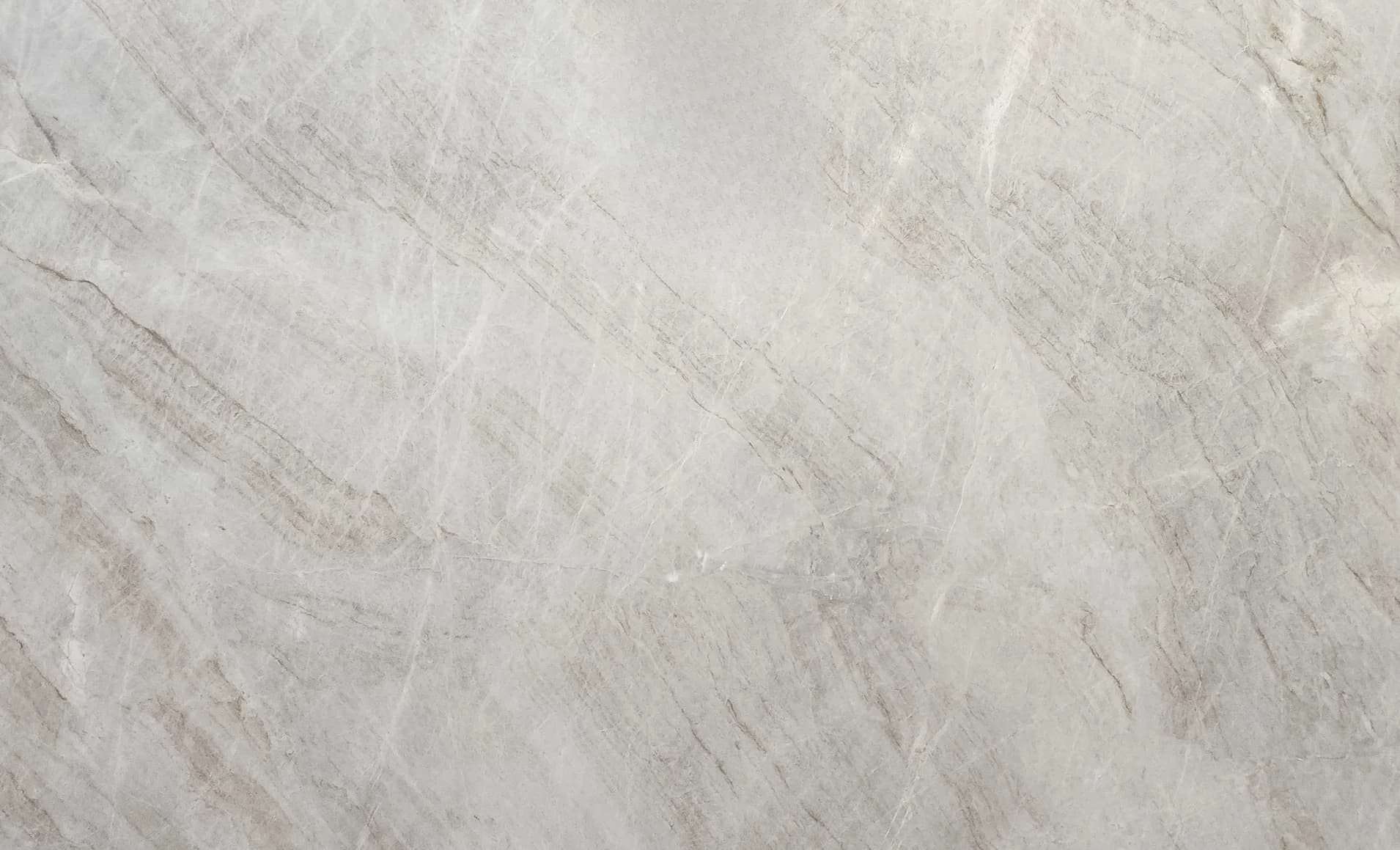
Taj MahalNatural quartzite
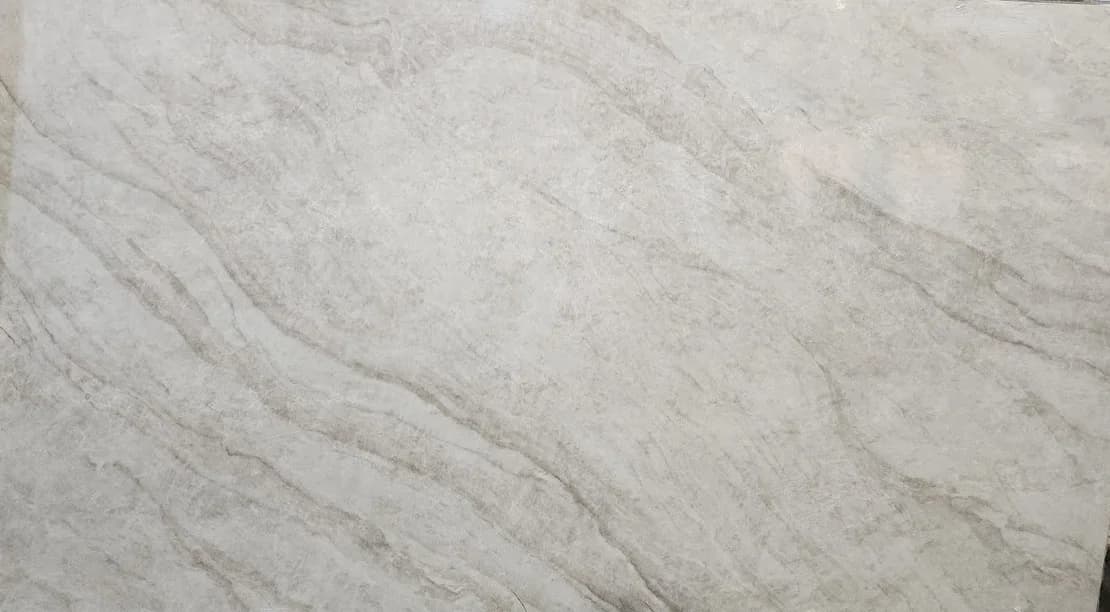
Taj Mahal QuartzEngineered quartz
Quartzite is a natural stone, cut from a quarry. Quartz is engineered stone, made in a factory from crushed stone and resin. They share a mineral and most of a name.
The difference decides whether a countertop can take a hot pan, stand in the sun, or go years without sealing. It also decides what you pay. And the name on a slab doesn't tell you which one you're looking at.
What is quartzite?
Quartzite is a hard metamorphic rock that started as quartz sandstone. Heat and pressure deep in the earth fused the sand grains into one solid mass.1 Because the grains are fused, the rock breaks through them rather than around them.
Its main mineral, quartz, rates 7 on the Mohs hardness scale. Glass rates 5.5, so true quartzite scratches glass.8 That one fact is the basis of the simplest test in this guide.
Every slab is different, so the slab you choose is the countertop you get.
What is engineered quartz?
Engineered quartz is crushed stone bound with a polymer resin. A typical mix is about 93% stone aggregate and 7% polyester resin by weight, pressed into slabs under vacuum and vibration.2
It's non-porous, so it never needs sealing.5 Its limit is the resin, which is less tolerant of heat and sunlight than stone. The next two sections cover both.2
Because a factory makes it to a design, a pattern repeats from slab to slab. What you approve from one slab is close to what arrives on the next.
How do quartz and quartzite compare?
| Property | Quartzite | Engineered quartz |
|---|---|---|
| Made of | Fused quartz sandstone, quarried | Crushed stone and polyester resin |
| Hot pans | No resin binder to scorch | Use a trivet every time |
| Outdoors in sun | No resin binder to discolor | Only lines rated for outdoor use |
| Sealing | Yes, it's porous | Never, it's non-porous |
| Pattern | Every slab is different | Repeats from slab to slab |
| Installed cost | $80 to $210 | $40 to $100 |
Which handles a hot pan better?
Quartzite. It's solid rock, not stone held together by resin.
Quartz manufacturers are direct about the risk. Caesarstone's warranty names thermal shock from "a hot pan, dish or other receptacle or object left on the countertop for more than a brief period" as a cause of cracking. It then says "trivets or hot pads should always be used" and that these issues "are not considered Product defects."3
A trivet is a good habit on any countertop. On quartz it's the condition of the warranty.
Can either go in an outdoor kitchen?
Quartzite can, because it has no resin binder for the sun to break down. Standard engineered quartz shouldn't, and a North Texas patio is the kind of long, direct sun the warnings describe.
The polyester resin in engineered stone is not fully UV stable.2 Caesarstone says its indoor quartz "can fade under prolonged exposure to direct sunlight."4 Its indoor warranty excludes "products installed in any outdoor application" and points buyers to a separate outdoor collection with its own warranty.3
If you want the engineered look outside, buy a line the maker rates for outdoor use and read that warranty. Otherwise choose a natural stone such as quartzite or granite, or a porcelain slab, which is UV-stable.
Does either need sealing, and does either etch?
Quartzite needs sealing. It's natural stone, and porous stone stains more easily.6 One fabricator in Stone World recommends prompt cleanup of spills and regular sealing.7 Reseal when water dripped on the surface stops beading. Quartz never needs sealing.
Etching is a different problem from staining. An etch is a dull spot where an acid such as lemon juice or vinegar has eaten the polish. Stones that contain calcite or dolomite etch; true quartzite doesn't.6
So it matters which stone a seller calls quartzite. A slab that etches isn't true quartzite, whatever its label says. In Dallas, hard water adds a second kind of mark around faucets, which the care guide covers.
Why can't you go by the name on the slab?
Stone names are trade names. They sell a look, and makers sell the same look in several materials.
KLZ's own catalog shows it. On October 22, 2026, it listed 57slabs with Calacatta in the name. By the material class in KLZ's inventory system, they split into 31 quartz, 19 marble, and 7 quartzite.
- Quartz
- 31
- Marble
- 19
- Quartzite
- 7
Slabs named Calacatta in the KLZ catalog on October 22, 2026, by material class.
The two slabs at the top of this page are both sold as Taj Mahal. One is a quartzite and one is an engineered quartz.
The harder case is a stone sold as quartzite that is really marble or dolomite. The Natural Stone Institute says "There is really no such thing as soft quartzite, and in most cases that term means the stone is marble." It names Super White as a stone made of dolomite.6 One fabricator told Stone World that white "quartzites" such as Mont Blanc "are most likely dolomites and will retain water, etch and stain much like marble."7
KLZ's inventory files both Super White and Mont Blanc under marble, not quartzite.
Dolomite isn't a bad countertop. At 3.5 to 4 on the Mohs scale it's harder than marble at 3,8 and it etches more slowly.9 But it isn't quartzite, and you shouldn't pay for it or care for it as quartzite.
How do you test a slab before you buy it?
Three kitchen-table tests, all from the Natural Stone Institute.6 Run them on an offcut or sample of the same stone, never on the face of a slab you have not bought.
The glass test
Press a pointed edge of the stone into a glass tile and draw it across. Quartzite scratches the glass. Marble and dolomite don't, and feel almost slippery as they glide over it.
Granite and sandstone also scratch glass, so this test separates quartzite from marble and dolomite, not from every hard stone.
The lemon test
Put several large drops of lemon juice or vinegar on a polished surface and leave them for 5 to 10 minutes. Wipe them off and look for a dull spot.
A dull spot means the stone contains calcite or dolomite and will etch in a kitchen. True quartzite stays glossy.
The water test
Stand the piece on its edge in a shallow bowl of water, partly submerged, and wait.
If it darkens, it absorbs water and is more likely to stain. Little or no darkening means low porosity.
Quartz needs none of these. Its maker and product line identify it, and both belong on the quote.
Which costs more?
Quartzite, usually. Fixr puts installed quartzite at $80 to $210 a square foot and installed quartz at $40 to $100, as national averages.10
Part of the gap is fabrication. Quartzite is hard on tools. "On all quartzites, we use special blades that cost more, and we run our saws slower," one fabricator told Stone World.7
The ranges overlap, and the stone decides where in them you land. KLZ doesn't publish prices. It quotes each slab by phone or email once you know which one you want.
Which should you choose?
Choose quartzite if
- you want a natural stone, and you want to choose the exact slab
- you cook hard, and pans come straight off the burner
- the countertop is outdoors or in strong sun
- you will reseal it when water stops beading
Choose quartz if
- you never want to seal a countertop
- you want the pattern to match from slab to slab, across a long run or an island
- you want a lower installed cost
- you will use a trivet every time
KLZ carries both. On October 22, 2026 the catalog listed 168 quartzites and 125 quartz products.
What should you ask before you buy?
- What material class is this slab filed under? If the answer is quartzite and the price looks like marble, run the glass and lemon tests on an offcut.
- Can I see the whole slab? Natural stone varies across a slab, so choose the slab itself by its tag number, not a sample.
- For quartz: which product line is it, and does its warranty cover where it is going?
- For quartzite: has my fabricator cut this stone before, and how do they price quartzite labor?
To see both materials before you decide, visit the Dallas showroom during opening hours. KLZ sells to the trade, so homeowners buy through their fabricator.
Sources
- 1Wikipedia, Quartzite. Read 2026-10-21.
- 2Wikipedia, Engineered stone. Read 2026-10-21.
- 3Caesarstone, Quartz, Mineral and ICON Surfaces Commercial Limited Lifetime Warranty (June 2025). Read 2026-10-21.
- 4Caesarstone, Does Quartz Fade in Sunlight? (2021). Read 2026-10-21.
- 5Caesarstone, Care and maintenance. Read 2026-10-21.
- 6Karin Kirk, How to Be Your Own Stone Sleuth, Natural Stone Institute (2020). Read 2026-10-21.
- 7Jennifer Richinelli, Fabricators Weigh in on Quartzite, Stone World (2024). Read 2026-10-21.
- 8Wikipedia, Mohs scale. Read 2026-10-21.
- 9Wikipedia, Dolomite (mineral). Read 2026-09-30.
- 10Adam Graham, How much does it cost to install quartzite countertops?, Fixr (updated August 29, 2025). Read 2026-10-21.