
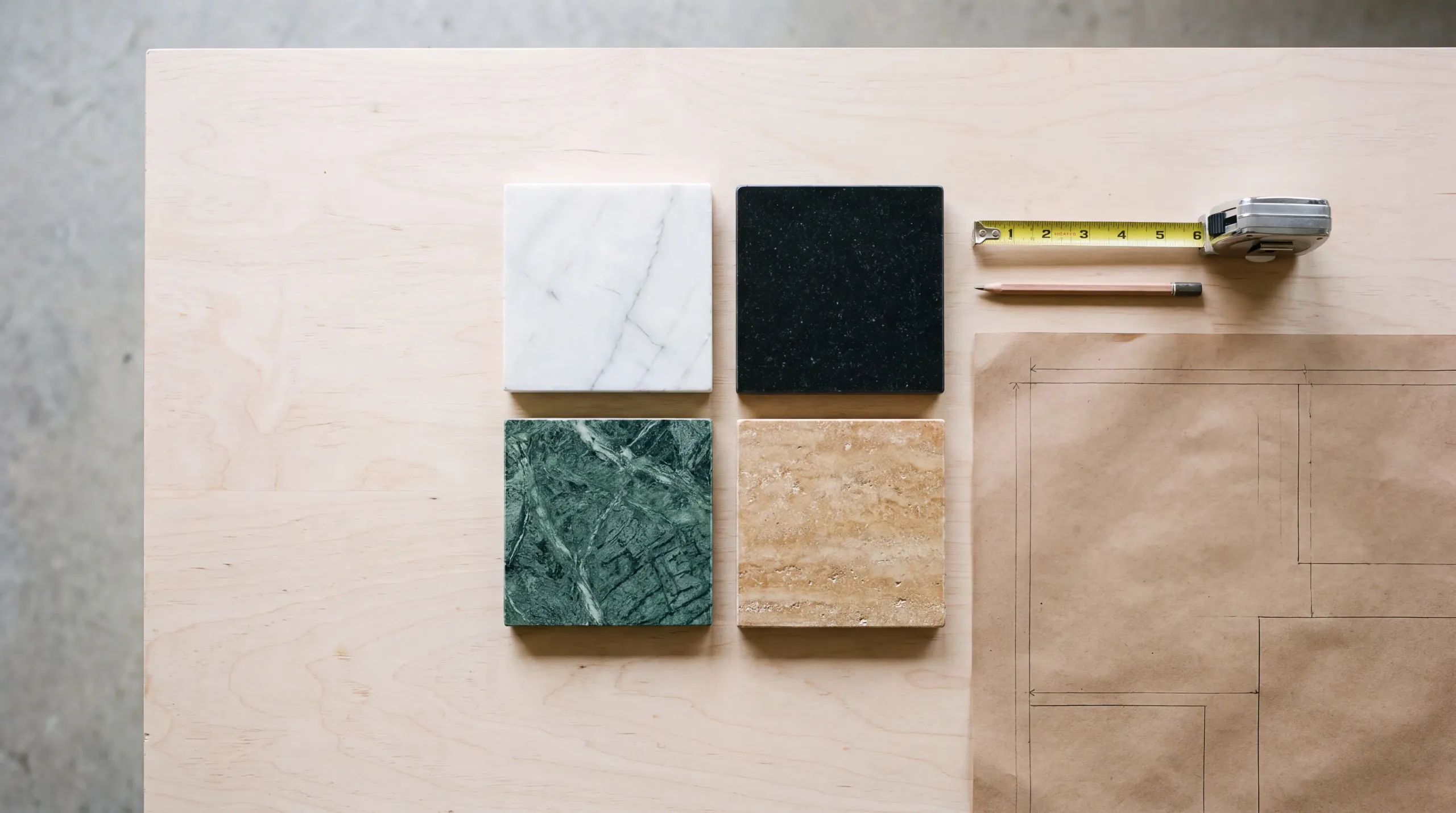
Countertop edge profiles: ten edges drawn to scale, and which ones suit 2 cm, 3 cm and porcelain
Eased, bullnose, bevel, ogee, mitered and waterfall edges drawn in section, with chip risk, cleaning, labor and thickness limits from maker and fabricator sources.
KLZ Stone Supply · · 15 min read
Eased
Pencil
Quarter round
Half bullnose
Full bullnose
Bevel
Ogee
Dupont
Mitered
2 cm stone, 5 cm face
Waterfall
What are the types of countertop edge profiles?
Ten edge profiles are in common use, in three families by what they do to the stone.
- Corner edges round or cut the top corner: eased, pencil, quarter round, half bullnose, full bullnose and bevel.
- Carved edges cut a curve into the face: ogee and Dupont.
- Built-up edges join pieces at 45 degrees: mitered and waterfall.
Brands name the same shape differently, and not every brand offers every edge in every market.12
Eased
- Fabrication effort
- Lowest (1 of 5)
- Chip risk
- Lower
- 2 cm
- Listed
- 3 cm
- Listed
- 12 mm porcelain
- Listed
Pencil
- Fabrication effort
- Lowest (1 of 5)
- Chip risk
- Lower
- 2 cm
- Listed
- 3 cm
- Listed
- 12 mm porcelain
- Not listed
Quarter round
- Fabrication effort
- Low (2 of 5)
- Chip risk
- Lower
- 2 cm
- Listed
- 3 cm
- Listed
- 12 mm porcelain
- Not listed
Half bullnose
- Fabrication effort
- Low (2 of 5)
- Chip risk
- Lower
- 2 cm
- Listed
- 3 cm
- Listed
- 12 mm porcelain
- Listed
Full bullnose
- Fabrication effort
- Moderate (3 of 5)
- Chip risk
- Middle
- 2 cm
- Listed
- 3 cm
- Caution
- 12 mm porcelain
- Listed
Bevel
- Fabrication effort
- Moderate (3 of 5)
- Chip risk
- Lower
- 2 cm
- Listed
- 3 cm
- Listed
- 12 mm porcelain
- Listed
Ogee
- Fabrication effort
- High (4 of 5)
- Chip risk
- Higher
- 2 cm
- Not advised
- 3 cm
- Listed
- 12 mm porcelain
- Not listed
Dupont
- Fabrication effort
- Highest (5 of 5)
- Chip risk
- Higher
- 2 cm
- Not listed
- 3 cm
- Not listed
- 12 mm porcelain
- Not listed
Mitered
- Fabrication effort
- High (4 of 5)
- Chip risk
- Middle
- 2 cm
- Listed
- 3 cm
- Listed
- 12 mm porcelain
- Caution
Waterfall
- Fabrication effort
- High (4 of 5)
- Chip risk
- Middle
- 2 cm
- Listed
- 3 cm
- Listed
- 12 mm porcelain
- Caution
| Edge | Fabrication effort | Chip risk | 2 cm | 3 cm | 12 mm porcelain |
|---|---|---|---|---|---|
| Eased | Lowest (1 of 5) | Lower | Listed | Listed | Listed |
| Pencil | Lowest (1 of 5) | Lower | Listed | Listed | Not listed |
| Quarter round | Low (2 of 5) | Lower | Listed | Listed | Not listed |
| Half bullnose | Low (2 of 5) | Lower | Listed | Listed | Listed |
| Full bullnose | Moderate (3 of 5) | Middle | Listed | Caution | Listed |
| Bevel | Moderate (3 of 5) | Lower | Listed | Listed | Listed |
| Ogee | High (4 of 5) | Higher | Not advised | Listed | Not listed |
| Dupont | Highest (5 of 5) | Higher | Not listed | Not listed | Not listed |
| Mitered | High (4 of 5) | Middle | Listed | Listed | Caution |
| Waterfall | High (4 of 5) | Middle | Listed | Listed | Caution |
What is an eased edge countertop?
An eased edge is a square edge with both corners slightly softened. Cambria calls it the simplest and most popular edge profile and lists it at 1, 2 and 3 cm.1
Dynamic Stone Tools calls it the lowest-cost profile to produce. It takes one finishing pass on the grinder after the saw cut, with a small chamfer on the top and bottom corners.12 Caesarstone tells fabricators not to leave square edges at all, so a "square" edge on quartz still gets a small radius.2
What is a pencil edge countertop?
What is a bullnose countertop edge?
A bullnose edge rounds the front of the slab into a curve. A full bullnose turns the whole edge into a half circle, and a half bullnose rounds only the top.
- Quarter round. Cambria sells its Piedmont as a half bullnose, a demi bullnose or a quarter round.1 Silestone limits the quarter round, the full round and the mitered skirt to straight sections, so a curved or radiused corner may rule them out.5
- Half bullnose. Dynamic Stone Tools describes it as keeping production simple.12 One fabricator wrote in Stone Business that the demi bullnose made up about 65% of his shop's monthly edge work. He says it looks good, is fast to process and makes clients happy.11
- Full bullnose. The radius is half the slab: 15 mm on 3 cm stone, 10 mm on 2 cm and 6 mm on 12 mm porcelain. Cambria sells it as Volcanic, a bullnose or full bullnose.1 It takes more profiling, and the radius and gloss must stay even around the curve.12 The same shop does not recommend it on 3 cm stone, because it makes the stone look thin.11
What is a beveled edge countertop?
A beveled edge replaces the top corner with a flat facet, usually cut at 45 degrees.1214 On 3 cm stone the facet is 1/4 to 3/4 inch wide. A consistent width along a long run takes operator skill or a mechanical guide.12 A Stone Business fabricator adds that a mistake in a 3 cm bevel is easy to see and hard to fix. A 2 cm bevel, he says, is a major step up in skill from a flat polish.11
On porcelain the "bevel" is a chamfer of a few millimeters. Laminam suggests at least 2 mm to strengthen the edge against accidental impact.7 Dekton Lite's manual gives minimums of 1 mm where the edge is not visible and 3 mm where it shows. It does not state its slabs' thickness.6
What radius or bevel size do makers ask for?
Sources give edge radii of about 1 to 6 mm. Caesarstone asks for at least 3 mm and says a larger radius resists chipping better.3
Sources put edge radii and bevels at 1 to 6 mm
- Eased, Dynamic Stone Tools1.6 to 3.2 mm12
- Pencil, Dynamic Stone Toolsabout 3 mm15
- Silestone, top corner3 mm5
- Silestone, lower corner1 to 3 mm5
- Caesarstone, minimum3 to 4 mm2
- Caesarstone, preferred4 to 6 mm3
- Caesarstone, best for durability6 mm2
- Laminam bevelat least 2 mm7
- Dekton Lite bevel, not visibleat least 1 mm6
- Dekton Lite bevel, exposedat least 3 mm6
What is an ogee countertop edge?
An ogee edge is an S-curve: a convex curve at the top, then a concave sweep in toward the vertical face.14 DeFusco calls it the most ornate profile and says it needs at least 3 cm. Dynamic Stone Tools says it can structurally weaken a 2 cm edge and suits 3 cm or laminated stone.12
Cambria lists its short ogee, Basin, at 3 cm and calls it its thinnest. Its full ogee, Glacial, appears only as "(+4cm)", a notation its page does not explain.1 Caesarstone's porcelain list has no ogee.2
Dynamic Stone Tools calls it typically the highest-cost standard profile. It needs a router bit on a router table or a CNC machine, plus small tools to polish the curves. Its fine detail is where chips are most visible and most likely.12 A Stone Business fabricator says it can be very tricky to polish without ripples.11
What is a Dupont edge?
I found no standard definition of a Dupont. Dynamic Stone Tools describes a small flat vertical section at the top, then a quarter-round under it, and gives no dimensions.12 A Stone Business fabricator says the Dupont and Q-profile are absurd to polish by hand. They have the highest price tag, he says, because many shops cannot execute them.11 Neither Cambria's nor Caesarstone's edge list names a Dupont, so ask the fabricator for their own template.12
What is a mitered edge countertop?
A mitered edge joins two pieces of the same stone at 45 degrees. The top and the front read as one surface turning a corner, and the front looks as thick as the strip you add.
2 cm eased
2 cm face
3 cm eased
3 cm face
2 cm mitered
5 cm face
Caesarstone says a laminated or mitered edge creates the appearance of a thicker slab,2 and Cambria says its miter gives a lighter countertop the appearance of a much heavier one.1 A fabricator told Stone World that designers usually choose a miter to "hide the lamination."8
Does a mitered edge make 2 cm look like 4 to 6 cm?
Yes: the face is as tall as the strip you choose. Dynamic Stone Tools says a 3 cm slab can give about 3 to 5 inches of apparent thickness,12 so a face of 4 to 6 cm is well inside that range. Thin stone is the easier base. A fabricator told Stone World that 2 cm typically miters better than 3 cm because it flexes slightly into position more easily, looks no different and is lighter to transport and install, and that many designers make the mistake of specifying 3 cm.8
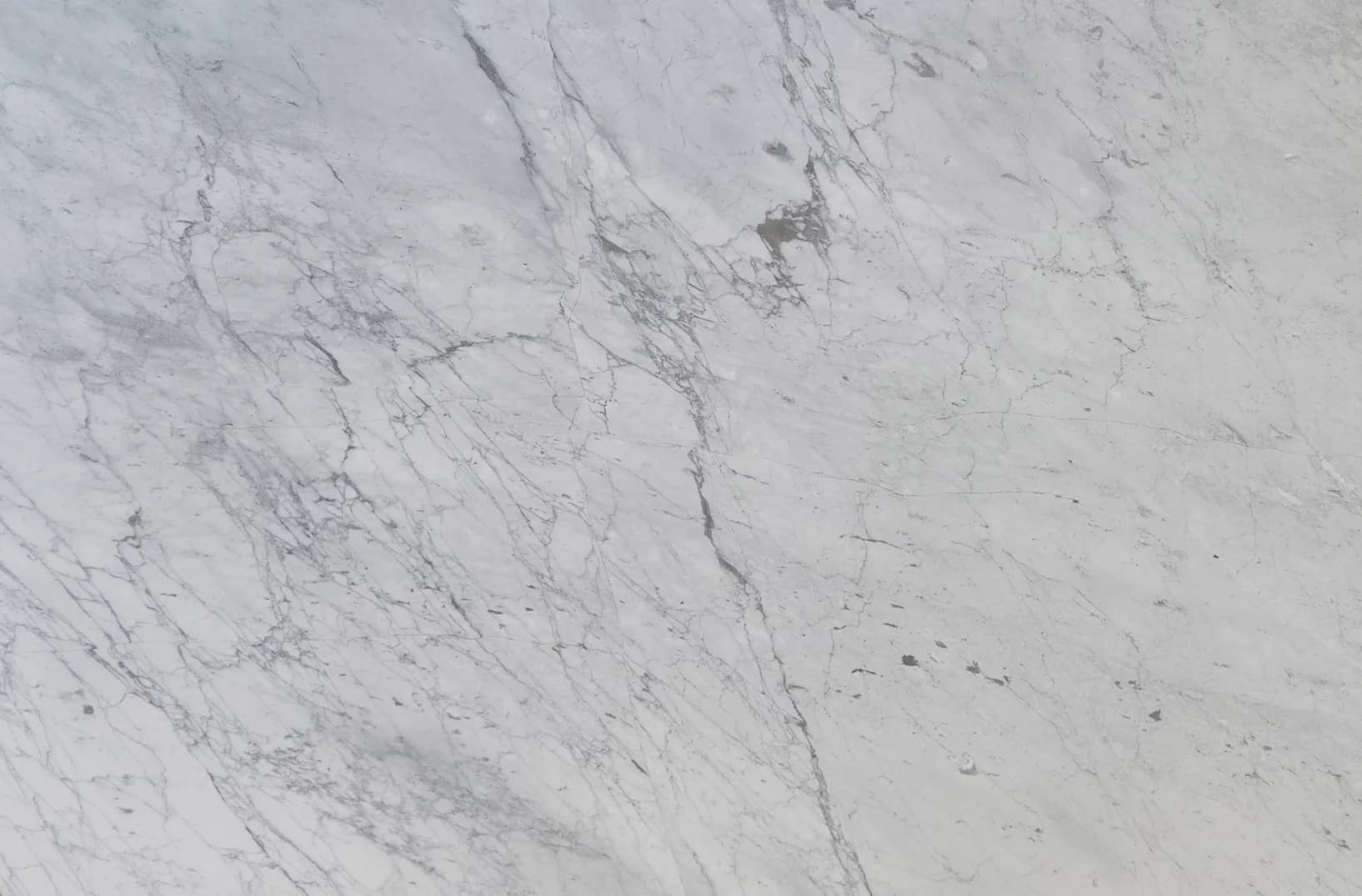
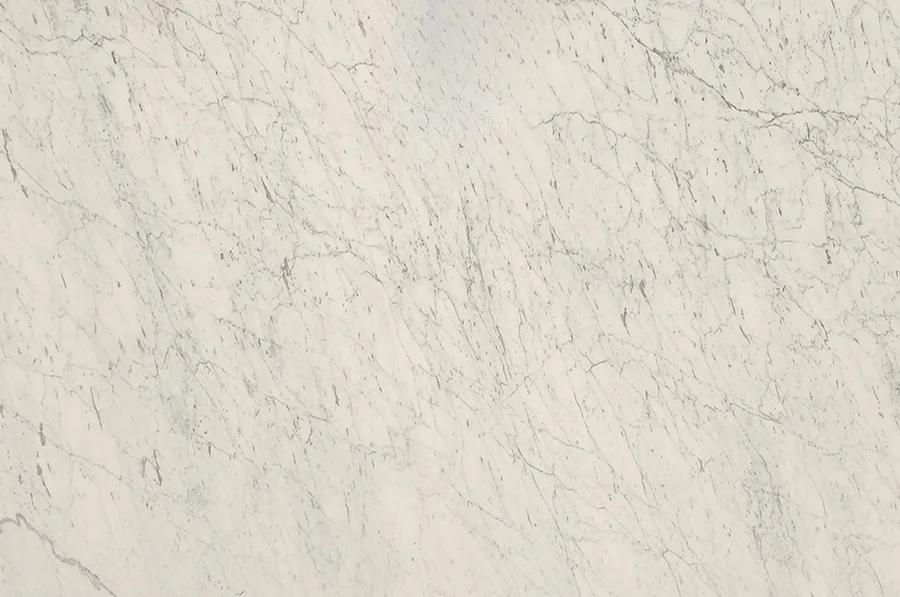
What does a mitered edge need?
Support and a clean joint. Silestone asks for reinforcement under miter edges, in line with the load-bearing structure of the cabinets.5 Dynamic Stone Tools says a well glued, supported miter is very durable. An unsupported overhang can crack at the glue joint under a point load.12 It can also be slow work. A fabricator told Stone World that many fabricators don't like to miter because it can be time consuming: his old bridge saw could take a sawyer nearly an entire day to cut a large mitered kitchen, and with a 5-axis CNC saw it is rare for a mitered slab to take more than a half hour.8
What is a waterfall edge countertop?
A waterfall edge continues the countertop down the side of an island or cabinet to the floor. It is usually a leg mitered to the top at 45 degrees.4
Stone World calls 3 cm quartz the go-to choice for waterfall edges, islands and other focal-point applications,9 and Cambria lists a 2 cm waterfall, Shale, that sits flush with the cabinet door.1 Dynamic Stone Tools lists the waterfall and the mitered edge as one profile. The work is the same: 45 degree cuts, gluing and clamping, and a polished joint.12 Each leg adds another miter joint, so in our reading the waterfall takes about the same work as a miter.
- Thickness. Caesarstone says all slabs used for the top and sides of a waterfall must be the same thickness.4 Silestone asks for the same thickness in the top and the leg of a miter joint. A butt joint fully adhered to the cabinets can be any thickness.5
- Support. Silestone says the top must rest on the cabinet structure and the leg must not raise it. The waterfall edge has no structural function: if it is pulled down, the joint will break and open, so it must be perfectly glued.5
- Overhang. Silestone limits a partial overhang beside a waterfall edge to 250 mm on 12 mm stone and 500 mm on 20 and 30 mm.5
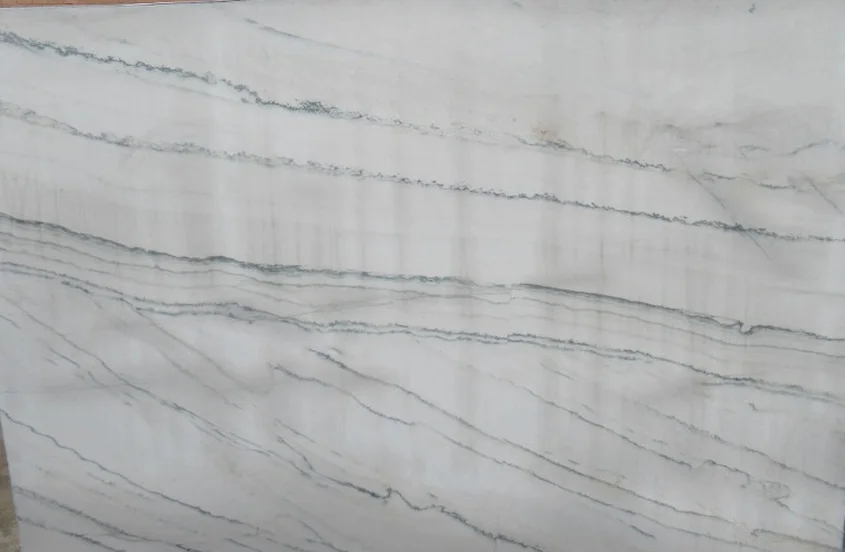
How does the veining wrap around a mitered or waterfall edge?
The veining wraps a mitered or waterfall edge when the top and the leg are cut from the same slab, in order. Lines that cross the cut then meet again at the corner. Stone World calls the effect a continuous, monolithic look.9
Caesarstone says to work with the fabricator so the slab is cut for book-matching and the top and side patterns align.4 For colors with a random pattern, Silestone's guide has the fabricator lay out the pieces with tone and vein pattern marked. The fabricator then matches areas of similar character at each joint.5
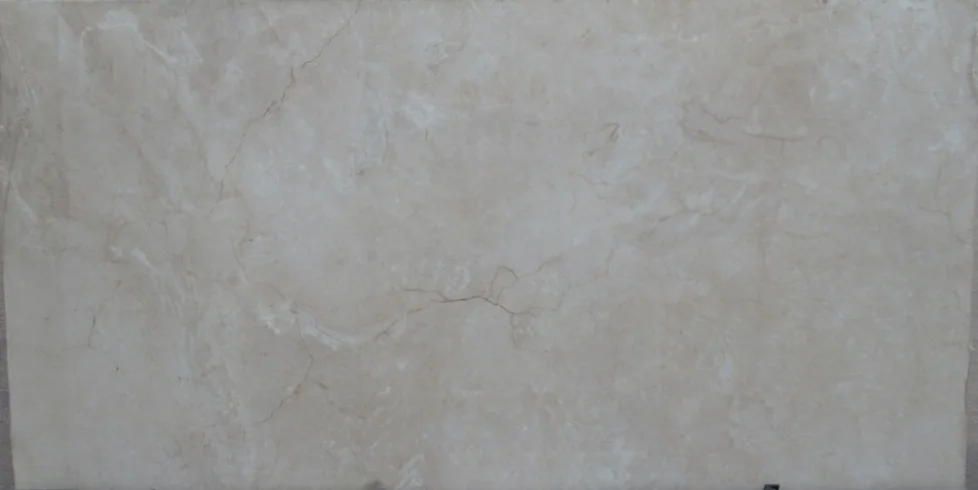
In our reading, the match depends on where on the slab each piece comes from, so choose the slab by its photograph and ask for a layout, not just a thickness. Veins that run along the slab, like those in the slab photographed here, cross the cut at a shallow angle and can read as one line across the corner. Veins that run across it hit the cut at a different place on each face.
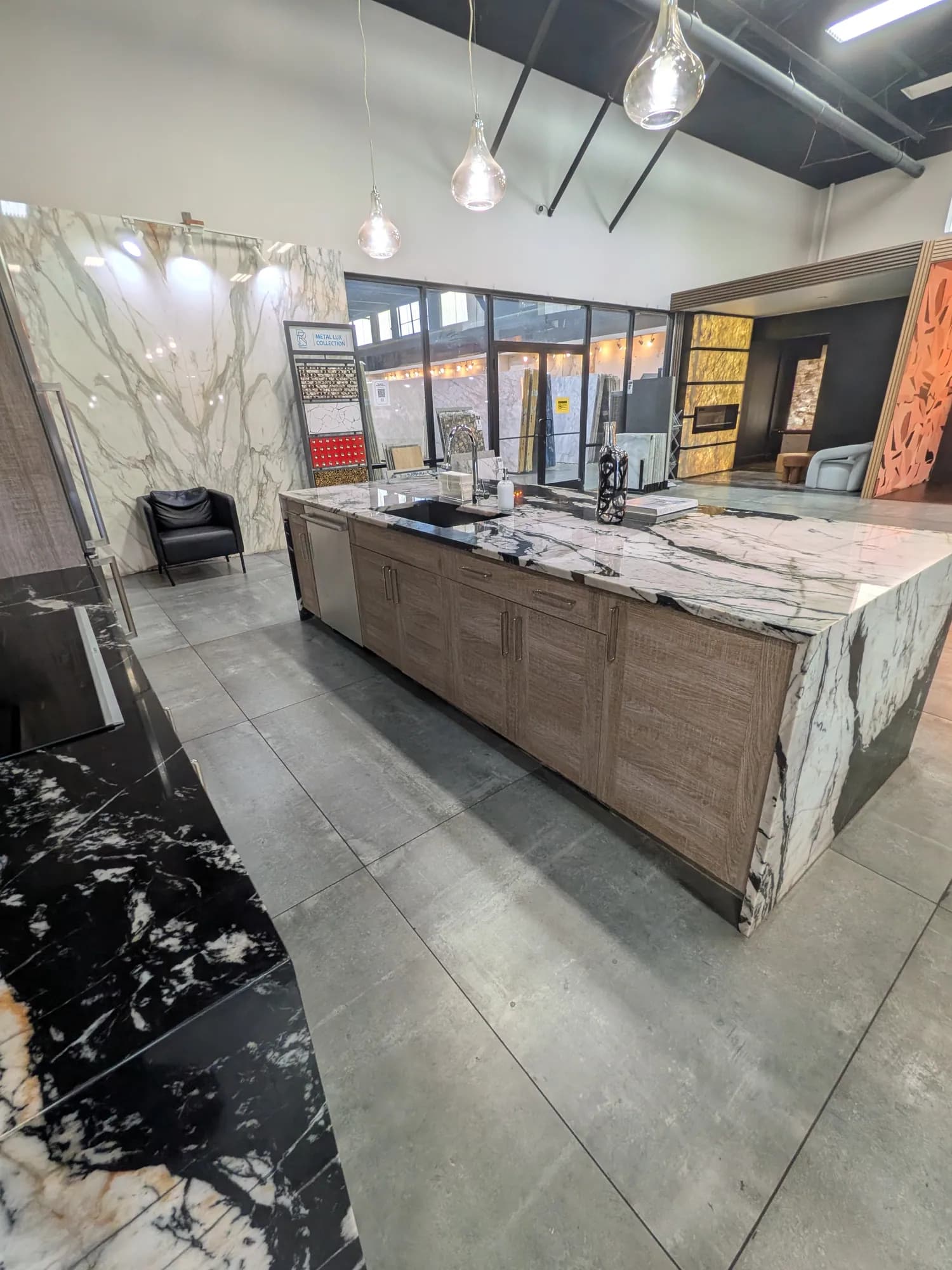
Caesarstone lists natural stone with bold, large-scale or unpredictable veining among the materials to avoid for a waterfall, because the patterns may not align.4 That is a quartz maker's view.
On porcelain, Stone World reports that through-body and double-loaded slabs matter at a mitered edge, because a through-body slab's bisque closely matches the top surface while a double-loaded slab carries the vein halfway into the material. A fabricator it quotes says granite miters can use a color-matched adhesive and that porcelain "is just not that way."10 To see a slab's pattern on an island, try it in a room.
Which edge profiles suit 2 cm, 3 cm and thin porcelain?
Most profiles are open on 3 cm stone, 2 cm suits the simple ones, and porcelain takes a small bevel.
2 cm
Stone World calls 2 cm quartz ideal for eased or pencil edges, lighter, easier to handle and gentler on the budget. It says fabricators can laminate or miter it for a heavier edge.9 One Stone Business fabricator offers only flat and bevel edges in 2 cm. He finds other 2 cm profiles a waste of time: a 2 cm ogee saves little time over a 3 cm one and earns less.11
3 cm
Stone World says the added thickness of 3 cm quartz improves edge durability, helping it resist chipping.9 Dynamic Stone Tools, a tooling seller, says profiling takes about 30 to 40% longer per linear foot than on 2 cm. Router bits wear faster.13 The Stone Business fabricator calls 3 cm the edge format of choice.11
A trade article gives 3 cm quartz a longer overhang than 2 cm
12 mm porcelain
Thin porcelain needs small, deliberate edges. Laminam's guide describes 45 degree joints reinforced with slats for taller panels and box structures.7 Caesarstone's porcelain list has no ogee, Dupont or pencil.2 The risk is the miter: Stone World quotes a fabricator calling it completely unforgiving, says the reality favors shops with higher-end machinery such as waterjets and miter saws, and notes that mitering is in many instances the only option for a thicker finished look in porcelain.108

Caesarstone quartz
Caesarstone porcelain
- Edges listed
- Eased, miter, half eased, semi bullnose, full bullnose, semi beveled2
- Thickness note
- Thin porcelain; see the maker for the thickness of each product
Cambria
- Edges listed
- Eased (Seacliff, Summit), straight (Ridgeline), bevels (Treeline, Ledge), half bullnose (Piedmont), bullnose (Volcanic). Ogees (Glacial, Basin), mitered (Rimrock, Idris), waterfalls (Shale, Boulder, Bryn, Cascade), chiseled (Moraine)1
- Thickness note
- Each edge listed at certain depths; some carry a (+4cm) or (+6cm) mark, which the page does not explain1
Silestone
Laminam 12+ and 20+
Dekton Lite
- Edges listed
- Bevel of at least 1 mm where hidden and 3 mm where exposed6
- Thickness note
- Lite worktops; see the maker for the thickness of each product
| Maker and product | Edges listed | Thickness note |
|---|---|---|
| Caesarstone quartz | Triple laminated bullnose, ogee, double bullnose, full bullnose, eased, double bevel, bevel, double radius, miter, pencil2 | Comes in 2 and 3 cm, by color2 |
| Caesarstone porcelain | Eased, miter, half eased, semi bullnose, full bullnose, semi beveled2 | Thin porcelain; see the maker for the thickness of each product |
| Cambria | Eased (Seacliff, Summit), straight (Ridgeline), bevels (Treeline, Ledge), half bullnose (Piedmont), bullnose (Volcanic). Ogees (Glacial, Basin), mitered (Rimrock, Idris), waterfalls (Shale, Boulder, Bryn, Cascade), chiseled (Moraine)1 | Each edge listed at certain depths; some carry a (+4cm) or (+6cm) mark, which the page does not explain1 |
| Silestone | Recommended: polished flat, half round, round, mitered skirt. Allowable: unpolished flat, quarter round, knife, ogee, double polished flat5 | One table for 12, 20 and 30 mm5 |
| Laminam 12+ and 20+ | Straight edge with a bevel of at least 2 mm; bullnose and half bullnose from CNC profiling grinders7 | 12.5 and 20.5 mm nominal7 |
| Dekton Lite | Bevel of at least 1 mm where hidden and 3 mm where exposed6 | Lite worktops; see the maker for the thickness of each product |
Which countertop edge is safest and most chip resistant?
A rounded edge does both, on the evidence of two fabrication guides. Choose a bullnose for homes with children, and an eased, half bullnose or bevel edge for resisting chips.
Chips start at sharp corners. Caesarstone tells fabricators not to create sharp edge profiles. It says the larger the surface area of the profile, the more resistant it is to chipping.3 Thickness helps: Stone World says 3 cm quartz improves edge durability.9 Dynamic Stone Tools puts the eased, bevel and half bullnose among the most durable profiles.12
Most durable
Eased
Bevel
Half bullnose
Middle
Full bullnose
Least durable
Ogee
Near children the corner matters more than the chip. DeFusco says a bullnose delivers maximum safety in homes with children or elderly residents,14 and Dynamic Stone Tools says the rounded edge of a half bullnose is less likely to cause injury.12 Dekton Lite's manual recommends beveling the outer edges to improve impact resistance and avoid possible cuts.6 In our reading, a chip can leave a sharp spot, so avoid the profiles most likely to chip near a child's head height.
Which countertop edge is easiest to clean?
A smooth convex edge with no groove: eased, bevel and the bullnoses, and in our reading the pencil.
DeFusco says the small curve of an eased edge reduces debris accumulation compared with flat edges. The smooth arc of a bullnose prevents debris buildup, and a flat bevel wipes clean without trapping debris.14 Cambria says simpler edges like eased or bullnose are easier to clean, while intricate profiles need more upkeep.1 DeFusco singles out the ogee: its concave curves trap dust, debris and liquid spills.14 No source I read rates a Dupont. In our reading, its inner corner, where the flat band meets the curve, is a place a cloth has to reach.
A mitered or waterfall edge has no groove in the profile. Look at the glue line: a fabricator told Stone World that if you can see it, there is room for improvement.8 DeFusco says the irregular surface of a chiseled edge traps dirt and moisture in crevices.14 Caesarstone asks fabricators to give every exposed edge the same finish as the surface.2 For the cleaning routine itself, see care and maintenance.
Which countertop edges take the most labor?
In our ranking, built from the sources cited in this section, the Dupont takes the most labor. The ogee, the mitered edge and the waterfall edge follow, and the eased edge takes the least.
Fabrication effort runs from the eased and pencil edges to the Dupont
- DupontHighest, 5 of 5
- OgeeHigh, 4 of 5
- MiteredHigh, 4 of 5
- WaterfallHigh, 4 of 5
- Full bullnoseModerate, 3 of 5
- BevelModerate, 3 of 5
- Quarter roundLow, 2 of 5
- Half bullnoseLow, 2 of 5
- EasedLowest, 1 of 5
- PencilLowest, 1 of 5
The ogee, miter and 3 cm are in their own sections. Four other things add labor:
- Steps. A bevel is ground with a wheel set at an angle.12
- Polishing. A Stone Business fabricator says the triple pencil is almost impossible to polish by hand.11
- Stacking. A Stone Business fabricator calls stacked profiles the most annoying and technically challenging way to build edges. You process the edge work twice: profile a piece, cut it into strips and glue it to a part already profiled.11
- Material. A fabricator told Stone World that porcelain and similar products need more specific tooling and tension-relieving techniques to miter.8
The gap between the simple edges is small. The Stone Business shop charges the same for its three standard 3 cm edges: flat, demi bullnose and bevel.11 Your fabricator sets the price, so ask which edges are in the base quote.
How do you choose a countertop edge profile?
Start with the thickness and rule out the edges the sources advise against for it. Then choose the corner by who uses the room: a bullnose for children, an eased or half bullnose for a busy kitchen.
Tool
Edge profile explorer
In words. Section through the front edge of a 3 cm slab. The top face runs level to the edge. Both corners are rounded with a 3 mm radius, and the front face between them is flat and vertical for 24 mm.
How it is drawn. Every thickness shares one scale, and the bar is 10 mm. The dashed outline is the square-cut slab before the profile is machined. 3 mm radius on both corners. Silestone draws its polished flat edge with 3 mm at the top and 1 to 3 mm below, and Dynamic Stone Tools gives 1/16 to 1/8 inch (about 1.6 to 3.2 mm) for an eased edge.
| Slab thickness | 30 mm |
|---|---|
| Top corner radius | 3 mm |
| Bottom corner radius | 3 mm |
| Flat front face | 24 mm |
Eased edge on 3 cm
A source lists it at this thickness.
Eased edge on 3 cm. A source lists it at this thickness. Fabrication effort lowest, chip risk lower.
- What it is
- Both corners of the front face are slightly softened and the face between them stays flat and vertical. Dynamic Stone Tools gives the softening as typically 1/16 to 1/8 inch (about 1.6 to 3.2 mm), and Cambria describes it as a straight, square line with slightly softened, rounded corners.121 Also sold as: Seacliff and Summit (Cambria), polished flat with a radius (Silestone).
- At 3 cm
- Cambria lists eased edges at 3 cm.1
- Fabrication effort, relative
- Lowest, 1 of 5. One finishing pass on the grinder after the bridge saw cut, which makes it the lowest-cost profile to produce.12
- Chip risk
- Lower. Rounding the corners reduces chipping, and Dynamic Stone Tools puts it among the most durable profiles. Caesarstone asks for a radius of at least 3 to 4 mm on any edge and calls 6 mm the best option for durability.122
- Cleaning
- No groove to clean out. DeFusco says the small curve collects less debris than a flat edge.14
- Near children
- A softened corner, not a round one: Silestone draws its polished flat edge with 3 mm at the top and 1 to 3 mm below. DeFusco says a bullnose delivers maximum safety in homes with children, so look there if children are the concern.514
- In quartz
- Caesarstone lists Eased. Cambria lists eased edges at 1, 2 and 3 cm. Silestone marks a polished flat edge as recommended at 12, 20 and 30 mm.215
- In porcelain
- Caesarstone's porcelain list includes Eased. Laminam suggests a bevel of at least 2 mm on its 12.5 and 20.5 mm slabs to strengthen the edge against accidental impact, and Dekton Lite's manual gives a minimum bevel of 3 mm on an exposed edge.276
- In natural stone
- Dynamic Stone Tools calls it the most popular profile in modern American kitchens. A fabricator writing in Stone Business calls the 2 cm flat polish (eased) the most basic and quickest edge a stone shop can make.1211
- The 3 cm thickness itself
- Stone World says 3 cm quartz improves edge durability, helping it resist chipping, allows overhangs of up to 24 inches (deeper may still need reinforcement), and is the go-to choice for waterfall edges and islands.9
Effort and chip risk are rankings built from what the sources describe, with our own reading where a note says so. They are not prices or test results, and no source ranks every pair. Radii and strip sizes are illustrative unless the note under the drawing names a source. Names and shapes vary by brand and shop, and not every brand offers every edge in every market. Ask the fabricator for their template.
Fix the thickness, then rule out what the sources caution against
At 2 cm, plan on a miter or a laminated strip for a heavier look. Avoid an ogee on 2 cm, and a full bullnose on 3 cm if you want the top to look substantial. Avoid a porcelain miter too: Stone World says it favors shops with higher-end machinery.See the slab, then the edge
Choose the slab at the Dallas showroom or try it in a room. Contact KLZ for hours.
Questions people ask
What are the types of countertop edge profiles?
The ten in common use are eased, pencil, quarter round, half bullnose, full bullnose, bevel, ogee, Dupont, mitered and waterfall. The first six round or cut the corner of the stone. Ogee and Dupont carve the face. Mitered and waterfall edges join pieces at 45 degrees to build height. Brands and shops name the same shape differently, so ask for the template.
Source: Cambria, Edge profiles (each profile with the depths it is listed in)
What is an eased edge countertop?
An eased edge is a square edge with both corners slightly softened, typically 1/16 to 1/8 inch (about 1.6 to 3.2 mm). Dynamic Stone Tools calls it the lowest-cost profile to produce, because it takes one finishing pass after the saw cut, and puts it among the most durable.
Source: Dynamic Stone Tools, Edge profiling techniques: every profile explained
What is the difference between a pencil edge and an eased edge?
A pencil edge rounds the top corner into a small, tight radius, which Dynamic Stone Tools puts at typically 1/8 inch (about 3 mm) and calls softer than an eased edge. Caesarstone lists them as separate edges for quartz. Shops differ on the radius, so ask the fabricator for it in millimeters.
Source: Dynamic Stone Tools, Stone edge profiles: the complete countertop guide
Is a bullnose edge safer around children?
A bullnose has the most rounded corner of the common profiles. DeFusco, a tool supplier, says a bullnose delivers maximum safety in homes with children or elderly residents, and Dynamic Stone Tools says the rounded edge of a half bullnose is less likely to cause injury. A half bullnose rounds only the top corner. A full bullnose rounds the whole edge into a half circle, with no corner at all, though Dynamic Stone Tools says its crown can show fine chips over time.
Source: DeFusco Industrial Supply, Types of countertop edge profiles (a tool supplier's guide)
Can you get an ogee edge on 2 cm stone?
A fabricator can cut one, but the sources advise against it. Dynamic Stone Tools says an ogee can structurally weaken a 2 cm edge, and DeFusco says it needs at least 3 cm. Dynamic Stone Tools says an ogee suits 3 cm or laminated stone.
Source: Dynamic Stone Tools, Edge profiling techniques: every profile explained
How does a mitered edge make 2 cm stone look thicker?
A strip of the same stone is joined under the front of the top at 45 degrees, so the front face is as tall as the strip plus the top. Stone World says mitered edges wrap the slab pattern around corners for a continuous, monolithic look. A fabricator told Stone World that 2 cm typically miters better than 3 cm because it flexes into position more easily.
What is a waterfall edge countertop?
A waterfall edge continues the countertop down the side of an island or cabinet to the floor, usually as a leg mitered to the top at 45 degrees. Caesarstone says every slab in a waterfall must be the same thickness, and Silestone asks for the same thickness in the top and the leg of a miter joint.
Source: Caesarstone, Waterfall countertops: what to know about this popular edge profile (December 12, 2025)
Sources
Each page was read on unless its own date is given.
- 1Cambria, Edge profiles (each profile with the depths it is listed in)
- 2Caesarstone Canada, Products technical info (edge profiles, minimum radius, thicknesses)
- 3Caesarstone, Common mistakes in fabrication, installation and post-installation (fabricator library)
- 4Caesarstone, Waterfall countertops: what to know about this popular edge profile (December 12, 2025)
- 5Cosentino, Silestone countertops: design and installation guide
- 6Cosentino, Dekton Lite worktops: manufacturing and fitting manual (April 2020)
- 7Laminam, Technical guide for furnishing and design, 1620x3240 12+ and 20+ (June 2021)
- 8Jason Kamery, Fabricators discuss the popularity of mitering and different techniques that are used, Stone World (November 2, 2015)
- 9Matt DiNorcia, Understanding the Practical Implications of Slab Thickness, Stone World (January 22, 2026)
- 10Jason Kamery, A Fabricator's Guide to Cutting Porcelain and Sintered Stone, Stone World (June 25, 2026)
- 11Mark Lauzon, a fabricator, Countertop Production: Edge Detail, Stone Business (May 4, 2006)
- 12Dynamic Stone Tools, Edge profiling techniques: every profile explained
- 13Dynamic Stone Tools, 2cm vs 3cm stone countertops: which thickness is right
- 14DeFusco Industrial Supply, Types of countertop edge profiles (a tool supplier's guide)
- 15Dynamic Stone Tools, Stone edge profiles: the complete countertop guide