
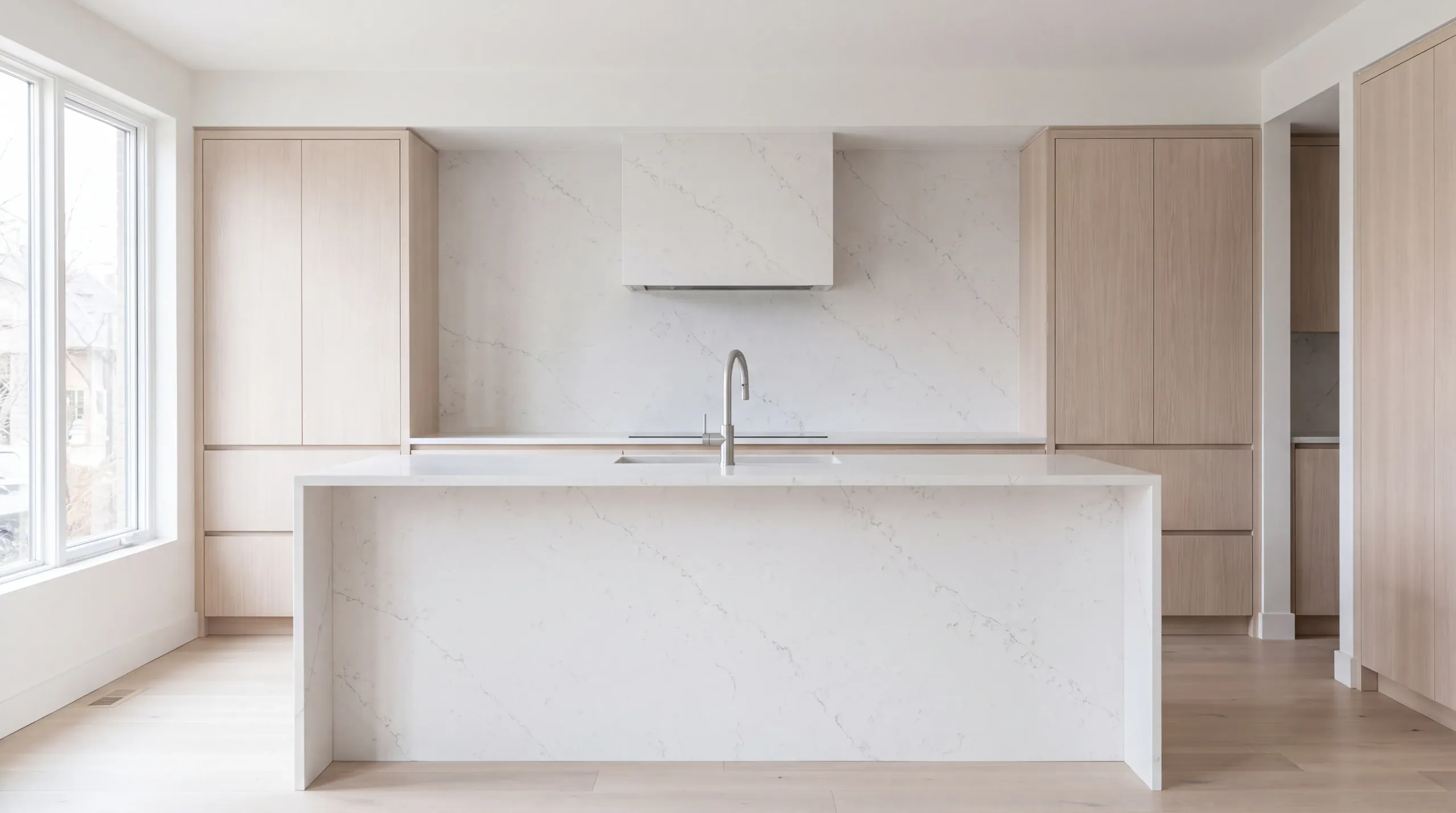
Quartz countertops: what they are, how to care for them, and what to know before you buy
What quartz countertops are made of, how they handle heat, stains and sun, how to clean them, and the silica risk to fabricators. Sourced.
KLZ Stone Supply · · Updated · 16 min read

What are quartz countertops made of?
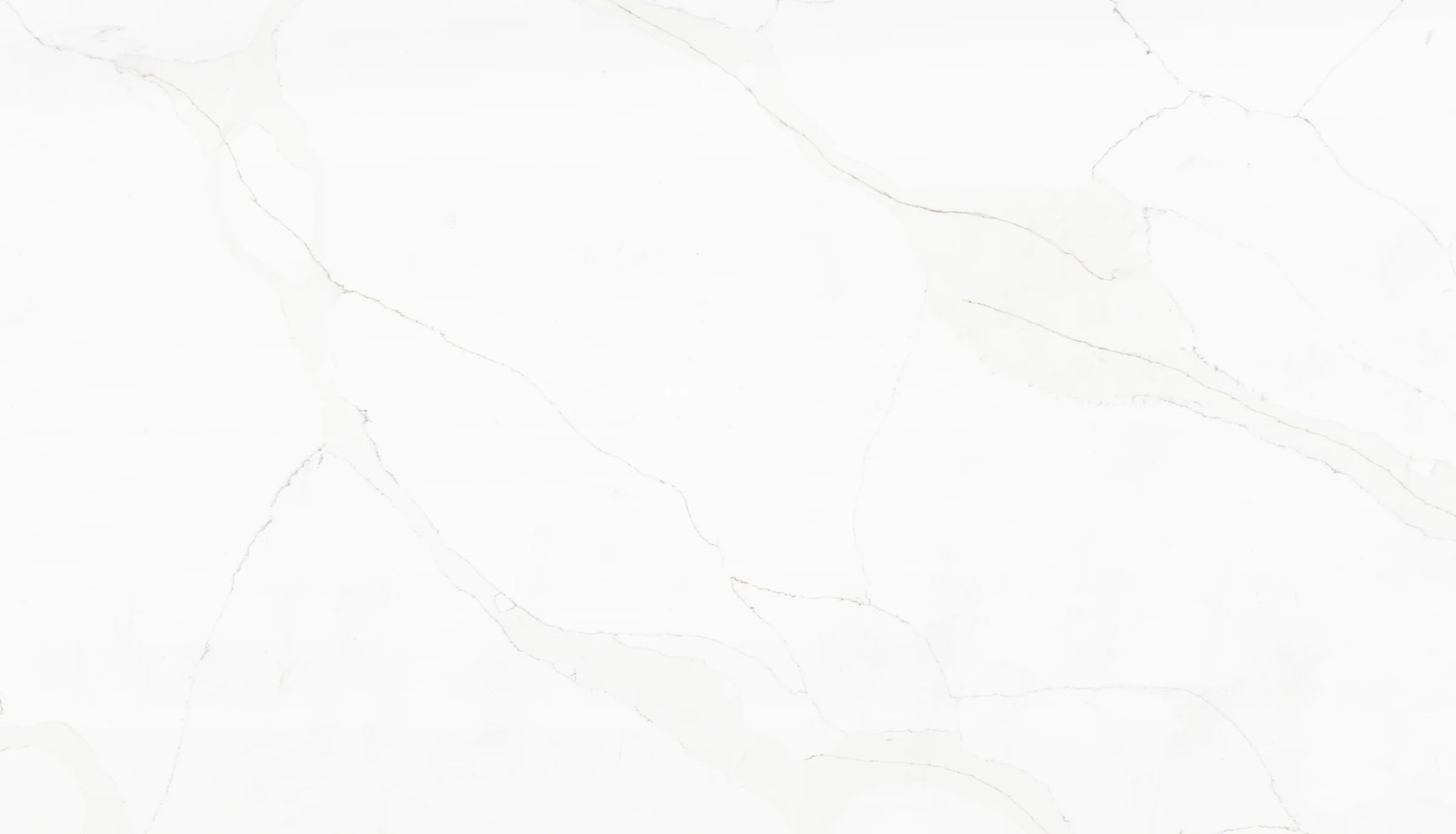
Quartz countertops combine crushed quartz with polyester resin. Silica makes up 90 to 93% of the slab by weight.1
By weight
93% stone, 7% resin
By volume
66% stone, 34% resin
Compaction under vacuum and vibration leaves virtually no porosity,1 which Cosentino says makes Silestone highly resistant to household stains.13 The resin is the weak part against heat and light, the Natural Stone Institute says.24
A factory builds to a design, so color and pattern stay consistent from slab to slab.1 Cambria warns that a sample is a small cut from a larger slab and may not show every design characteristic,4 so look at a whole slab first.
Quartz, the main mineral, rates 7 on the Mohs scale, and glass rates 5.5.3 Makers say no stone is scratch-proof or chip-proof.4 This guide covers engineered quartz, not the natural stone quartzite.
How is a quartz slab made?
A factory presses crushed stone and resin into a slab under vacuum while the mix vibrates, and heat cures the resin.
Mix
A factory combines crushed stone and resin.1Vacuum, vibrate and press
The air comes out and the grains pack tight.2Cure with heat
The resin hardens in a heated vacuum press.1Rest for 24 to 48 hours
The slab sits before polishing.1Polish
The slab gets its finish.1
Breton S.p.A. developed the method, called vibro-compression under vacuum, and its founder, Marcello Toncelli, had the idea to vacuum the mixture. The company dates its first vacuum vibro mixer plant to 1968 and BretonStone technology to 1975.2 The first version bound marble fragments with polyester resin. It looked like granite but behaved like marble, so the second generation used harder aggregates: silica sand, quartz and granite. Quartz later became the usual one.2
How do you clean and polish quartz countertops?
Wipe quartz with a soft cloth and warm water, with a little mild soap if you like.
Treat dried-on marks over a wider area
Caesarstone says to clean a larger area rather than the stain itself, in a circular motion, with an approved cleaner, then rinse.7
Can you polish quartz?
No: makers say not to seal or polish it.
Cambria
- What it says
- Sealers, penetrants and topical treatments wear off and leave the gloss dull or inconsistent4
Cosentino
- What it says
- No water repellents, sealants or polishes, and do not polish the surface13
Caesarstone technical manual
- What it says
- Never use a sealant of any kind, because it leaves a topical film that makes cleaning harder21
Clorox, a cleaner maker
- What it says
- A dull surface is often residue, and washing and careful rinsing usually bring the shine back17
| Source | What it says |
|---|---|
| Cambria | Sealers, penetrants and topical treatments wear off and leave the gloss dull or inconsistent4 |
| Cosentino | No water repellents, sealants or polishes, and do not polish the surface13 |
| Caesarstone technical manual | Never use a sealant of any kind, because it leaves a topical film that makes cleaning harder21 |
| Clorox, a cleaner maker | A dull surface is often residue, and washing and careful rinsing usually bring the shine back17 |
Can you use Clorox wipes or bleach on quartz?
Check the label before you wipe quartz with a disinfecting wipe, and without knowing your maker, skip bleach. Clorox says its Disinfecting Wipes work on hard, nonporous quartz when used as directed. It marks its Disinfecting Bleach and Disinfecting All Purpose Cleaner as not suitable, and says to follow your maker’s care recommendations.17 Caesarstone says to make sure wipes are safe for quartz. It warns that a label claim is not always enough, and that damage from an unsuitable product can void the warranty.12
Cambria and HanStone
Caesarstone
Silestone, US website
- Bleach
- Bleach can damage the surface after prolonged exposure, from 2 hours. A diluted bleach solution is fine every day if you rinse well after each use.26
Silestone, care PDF
- Bleach
- Avoid chlorine-based products, and rinse bleach off at once rather than leave it13
| Maker | Bleach |
|---|---|
| Cambria and HanStone | Both name bleach among the products to keep off the surface414 |
| Caesarstone | Its disinfecting page lists bleach among the chemicals to keep away.12 Its 2021 technical manual recommends a Soft Scrub gel with bleach for polished finishes.21 |
| Silestone, US website | Bleach can damage the surface after prolonged exposure, from 2 hours. A diluted bleach solution is fine every day if you rinse well after each use.26 |
| Silestone, care PDF | Avoid chlorine-based products, and rinse bleach off at once rather than leave it13 |
Caesarstone’s own papers disagree, and Cosentino’s website is more relaxed than its PDF.
Tool
Can I use this cleaner on my quartz?
Pick a cleaner and your slab’s maker for an answer from four care guides.
Fine to use
Every guide read allows it.
What each of the four guides says
Fine to use. Names warm water with a mild detergent and a soft cloth for everyday cleaning.
Fine to use. Says to wash with a soft cotton cloth and warm water, with a mild soap if you like.
Fine to use. Recommends its own Q-Action cleaner, and names water with neutral soap as the alternative, then a rinse and a dry cloth.
Fine to use. Names soap and water for regular cleaning, on a damp cloth.
Built from the care guides of Caesarstone, Cambria, Silestone and HanStone, read 2026-11-18. Your own product line's guide or warranty comes first. If you don't know your maker, the checker gives the strictest answer and says “fine” only when every guide agrees.
Do quartz countertops stain, and how do you remove a stain?
Quartz resists stains, but it is not stain-proof. HanStone calls its quartz non-porous and highly resistant to stain, and says to clean spills as soon as possible.14 Chemicals are the bigger risk: Cambria says strong chemicals can damage the surface,4 and the guides warn about strong alkalis, acids, solvents and paint strippers.
Grease
- What the guide names
- Q-Action multi-purpose spray or neutral soap, rubbed with the soft side of a sponge, then rinse13
- Maker
- Cosentino
Limescale
- What the guide names
- Cleaning vinegar on a damp sponge, then a diluted remover for 2 minutes at most, then rinse and dry13
- Maker
- Cosentino
Ink
- What the guide names
- Ethyl alcohol on a paper towel, not poured on the mark13
- Maker
- Cosentino
Silicone or putty
- What the guide names
- A knife blade held flat, then a silicone remover13
- Maker
- Cosentino
Rust and metal marks
- What the guide names
- Bar Keepers Friend cleanser or oxalic acid on a damp cloth, no abrasive scourer7
- Maker
- Caesarstone
Wine and dyes
| Mark | What the guide names | Maker |
|---|---|---|
| Grease | Q-Action multi-purpose spray or neutral soap, rubbed with the soft side of a sponge, then rinse13 | Cosentino |
| Limescale | Cleaning vinegar on a damp sponge, then a diluted remover for 2 minutes at most, then rinse and dry13 | Cosentino |
| Ink | Ethyl alcohol on a paper towel, not poured on the mark13 | Cosentino |
| Silicone or putty | A knife blade held flat, then a silicone remover13 | Cosentino |
| Rust and metal marks | Bar Keepers Friend cleanser or oxalic acid on a damp cloth, no abrasive scourer7 | Caesarstone |
| Wine and dyes | Cosentino’s chart lists diluted bleach,13 and its website says to leave it 2 minutes, then rinse.26 | Cosentino |
Dallas water leaves its own marks, and the care guide covers them.
Are quartz countertops heat resistant?
Only up to a point, because the resin is the weak part. MSI says extended or excessive heat can soften, discolor or even scorch the resin.15 No maker’s care guide gives a safe temperature. MSI, an importer, says quartz normally tolerates heat up to roughly 150°F before the resin starts to break down or discolor. It says cast-iron skillets and baking sheets can reach 300 to 500°F.15
Skillets run far hotter than MSI’s 150°F figure
A cast-iron skillet heated to about 570°F sat for 10 minutes on two polished engineered quartz samples in a Natural Stone Institute test. It left a temporary, light-colored mark on one that wiped off, and no visible effect on the other.23 The author notes that makers warn against putting hot pans directly on their surfaces. Two samples are not a rating, so use a trivet.
Two ways heat hurts quartz
Scorching is the first: the resin discolors or marks where something hot sat. The second is thermal shock, a crack from a fast change in temperature. Caesarstone’s US residential warranty says it can occur when a hot pan, dish or other object is left on the countertop for more than a brief period. It names it as one of the two main reasons for seam separation or cracking, the other being the shifting or movement of the substrate, cabinets or foundation.8 HanStone says extreme temperature changes, prolonged or sudden, can damage any surfacing material, stone included.14
Can you put a hot cup of coffee on quartz?
No maker’s care guide sets a temperature for a mug. Cosentino’s rule is the broadest: do not place any object that gives off heat, or that has just come off the cooker, onto the surface.13 Use a coaster, and keep a trivet by the stove. HanStone says its quartz can withstand normal cooking environments for brief periods, and the word is brief.14 Every maker asks for the same habit, a trivet, and the makers table lists each one’s advice.
Can quartz countertops go outside or sit in direct sun?
Makers build standard quartz for indoors, and prolonged direct sun can fade it. Caesarstone says indoor quartz can fade under prolonged exposure to direct sunlight, and that UV rays bleach just about any pigmented surface.9 The Natural Stone Institute says it can begin to fade or turn yellow within weeks.24 The sources differ on the cause: Wikipedia says polyester resins are not completely UV stable, so engineered stone should stay out of outdoor applications,1 while the Natural Stone Institute blames pigments that do not mix well with UV rays.24
The makers table lists what Cosentino and Caesarstone say about outdoor use. An outdoor-rated line is a different product. Caesarstone’s outdoor guide says its Outdoor Collection is built to withstand UV rays, has a 2 cm slab thickness, and sits on a full substrate of concrete, brick or cement board, not wood, because wood swells outdoors. A grill must stand on its own support, not on the quartz.10
What is the downside to quartz countertops?
The downsides trace to the resin and to the way a slab is cut. None is a reason to avoid quartz.
- Heat. The resin can scorch, and thermal shock can crack it.15
- Sun. Standard indoor lines can fade outside.9
- Seams. Cambria says seams are visible, with a change in pattern and shade.4 HanStone says to place them so they do not look out of place.14
- Edges. Quartz resists surface damage, but edges at sinks and dishwashers can chip.4
- Silica dust. Cutting, polishing and grinding can expose workers to it.18
Is quartz better than granite?
Neither wins every round, and which is better depends on how you cook and where the slab sits. Cambria and Cosentino say not to seal quartz, so there is nothing to reseal.413 Granite is natural stone without a resin binder, and the Natural Stone Institute says engineered quartz is not as resistant to heat as natural stone.24 Silica differs too, and the silica section puts the figures side by side.
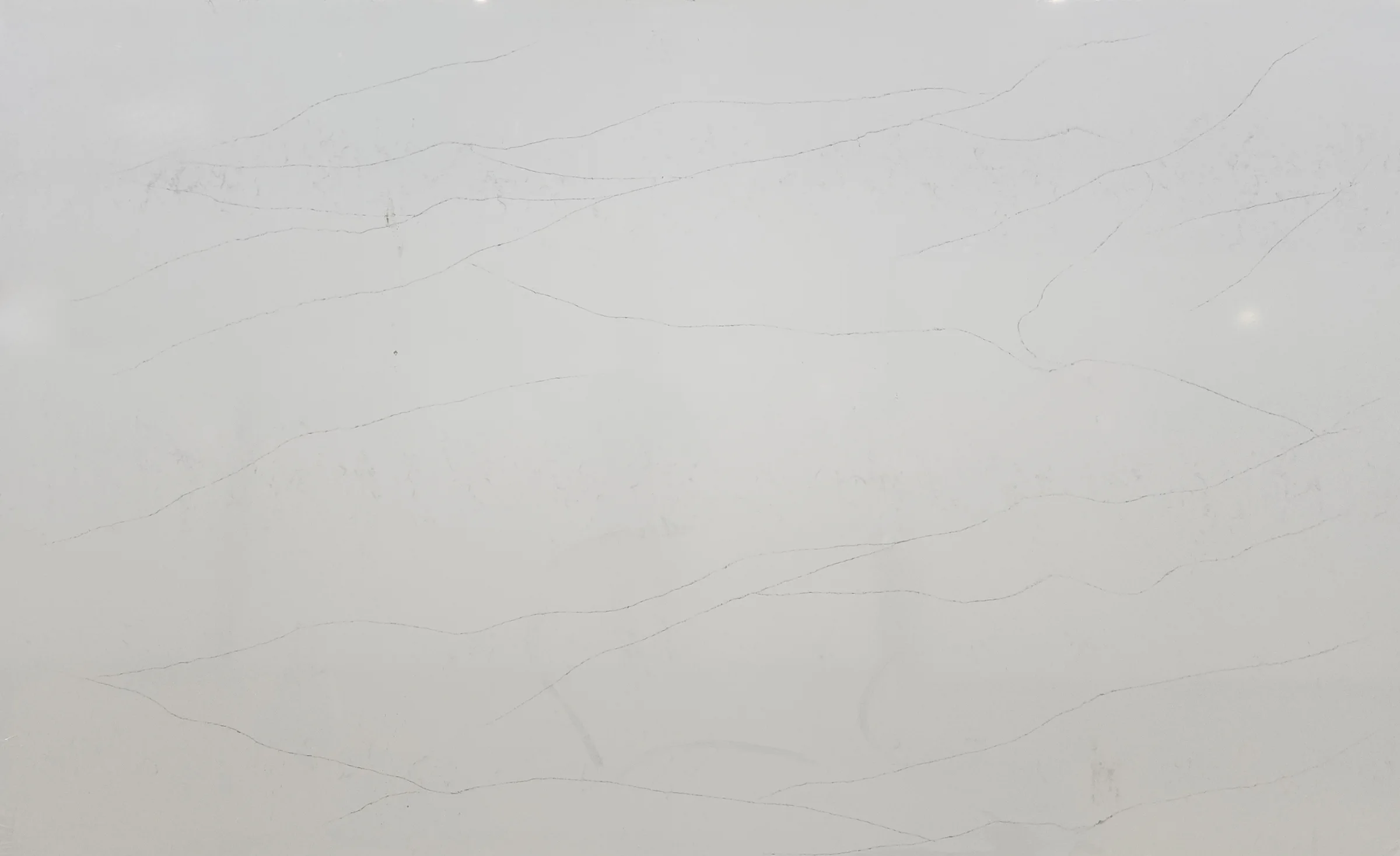
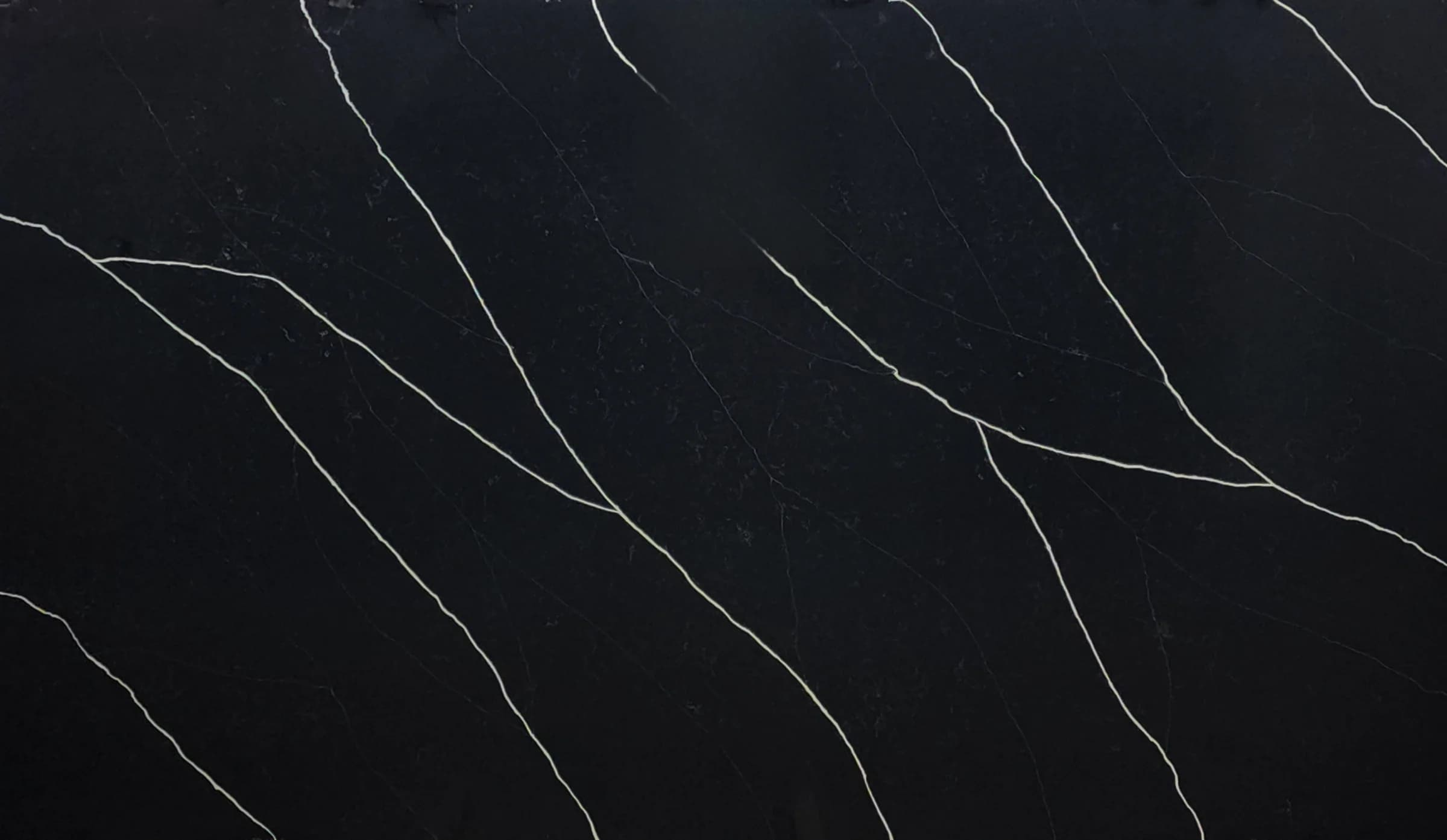
Pick quartz for a uniform look and no sealing, and granite when pans come straight off the burner. KLZ’s catalog lists both, each photographed as a whole slab.
How much do quartz countertops cost?
Six things set the price. This guide gives no dollar figure, because the number changes with them.
- Design. MSI says bold veining, high contrast and marble-inspired designs tend to cost more.16 Cambria says large veining can need extra slab to align across seams.6
- Thickness. MSI says the thicker the slab, the more it costs.16
- Edge profile. Cambria says any edge needing advanced skill or specialized tools costs more.6 MSI says waterfall edges are often one of the most expensive upgrades.16
- Cutouts. MSI says undermount sinks need more precise cutout work than drop-ins, and each opening adds labor.16
- Seams and layout. Both makers say more seams and more complex layouts raise labor.166
- Region, access and removal. Difficult access and regional rates change the price, and removal of the old countertop is often not included.166
How big is a quartz slab, and where do the seams go?
A quartz slab is about 10 to 11 feet long and 4.5 to 5.5 feet wide, and a run longer or wider than the slab needs a seam.514 The most common format is 3040 mm by 1440 mm.1
Cambria jumbo
- Slab size
- 132 × 65.5 inches5
- Note
- Nominal 60 sq ft
Cambria standard
- Slab size
- 122 × 55.5 inches5
- Note
- Nominal 47 sq ft
HanStone
- Slab size
- 130 × 65 inches usable14
- Note
- 2 cm and 3 cm
Caesarstone Outdoor
- Slab size
- 120 × 56.5 inches10
- Note
- 2 cm slab
| Maker | Slab size | Note |
|---|---|---|
| Cambria jumbo | 132 × 65.5 inches5 | Nominal 60 sq ft |
| Cambria standard | 122 × 55.5 inches5 | Nominal 47 sq ft |
| HanStone | 130 × 65 inches usable14 | 2 cm and 3 cm |
| Caesarstone Outdoor | 120 × 56.5 inches10 | 2 cm slab |
Cambria says to check with your fabricator about the largest slab size the shop can make, which may differ from the size listed.5 HanStone lists four reasons for a seam. The top may be longer than the slab, or a split may waste less material. The finished top may weigh too much in one piece, or the layout may call for it.14
Tool
How many slabs does your countertop need?
Enter your measurements for an estimate of the slabs you need. Your fabricator lays out the real cut.
Your result
Total 64.9 sq ft of stone. Estimated slabs: 3 of Standard quartz, 120 x 56.5 in (Caesarstone); 3 of Standard quartz, 122 x 55.5 in (Cambria); 3 of Jumbo quartz, 132 x 65.5 in (Cambria).
Square feet
- Counters
- 38.0 sq ft
- Island
- 21.0 sq ft
- Backsplash
- 6.0 sq ft
- Total
- 64.9 sq ft
Sink and cooktop cutouts are not subtracted: the slab is used up whether or not the cutout piece is kept. Edge strips for a laminated or built-up edge are not included.
Overhang check
Sources disagree. 12 in is past the strictest source (10 in at 3 cm) and inside the most generous (15 in). Plan corbels or brackets, or get your fabricator's written limit for your slab.
- Check: Knee space: 12 in is under NKBA's 15 in. NKBA asks for 24 x 15 in of knee space per diner at a 36 in counter. With a solid cabinet face, the overhang is that knee space.
- Meets: Seats: 3 at 24 in each along 84 in. NKBA plans 24 in of width for each seated diner.
- Meets: Proportion: within a third of the 36 in top. A third is 12 in. HanStone caps an unsupported overhang there, and Caesarstone and the Natural Stone Institute manual cap any overhang there. Cambria words its cap as a third of the base cabinet depth.
Natural stone (Natural Stone Institute manual)
10 in unsupported at 3 cm
Needs support
HanStone
no extra support to 12 in; corbels 24 in on centre to 20 in; legs or columns beyond
Within its limit
Cambria
extra support past 15 in; full substrate and vertical support every 36 in past 24 in; no overhang over a third of the base cabinet depth
Within its limit
Silestone (Cosentino), island, no cut-out in the overhang
up to 39 in at 3 cm on one side if the support behind it is at least twice the overhang deep (36 in where two sides overhang)
Within its limit
Along this run, corbels spaced no more than 24 in apart (HanStone) come to about 5; at Cambria's 36 in, about 4. Your fabricator sets the real spacing.
Slabs, an estimate
| Slab size | Slabs | By area alone | Seams cut in |
|---|---|---|---|
| Standard quartz, 120 x 56.5 in (Caesarstone) | 3 | 2 | 2 |
| Standard quartz, 122 x 55.5 in (Cambria) | 3 | 2 | 2 |
| Jumbo quartz, 132 x 65.5 in (Cambria) | 3 | 2 | 2 |
An estimate, not a quote. Pieces are laid in rows across each slab, tallest first, turned 90 degrees where that saves stone. A piece longer than a slab is cut in equal parts, and each cut is a seam. Your fabricator's layout decides the real count: it also weighs the veining, the seam positions and which part of each slab is usable.
Assumed: 1 in trimmed off every slab edge and 0.5 in between pieces. These two allowances are this guide's own, not a slab maker's figures. Change both under "Your own slab size and cutting allowances". "By area alone" is the lowest count any layout could reach.
Slab sizes are the published sizes of Caesarstone US, countertops and Cambria, slab product information. Sizes differ by color and by maker.
Where should the seams go?
Away from the sink, the cooktop and the dishwasher. HanStone’s manual says to try to minimize the number of seams and not to place them within 6 inches of cutouts, over a dishwasher or trash compactor, or within 18 inches of a finished end. Corners need a radius of at least 3/8 inch.14
Caesarstone asks for a minimum 10 mm radius on every cutout corner. It says a radius that is too small or badly cut can crack sink and cooktop cutouts.11 It also asks for wooden support strips under seams, with the center of the seam resting on the strip. It ties cracks to unstable cabinets, and to poor support on long seams and void areas.11 Cambria says its slabs are not structural support and need support in every application.4
Which companies make quartz countertops?
The makers you will meet in the US include Caesarstone, Cambria, Cosentino’s Silestone, Hyundai L&C’s HanStone and MSI. The care guides of the first four differ on heat and outdoor use, as the table shows.
Caesarstone
Cambria
- Heat
- Not heat-proof. It may not withstand direct heat from cooking units. Those include pots, pans, electric frying pans, griddles, slow cookers, roaster ovens and heat lamps. Use a closed-weave hot pad or a solid trivet4
- Outdoors
- The guide read does not say
Silestone
HanStone
- Heat
- Brief normal cooking, use non-metal trivets with non-metal legs14
- Outdoors
- The manual read does not say
| Maker | Heat | Outdoors |
|---|---|---|
| Caesarstone | Always use trivets and hot pads7 | The US residential warranty does not cover products installed in any outdoor application8 |
| Cambria | Not heat-proof. It may not withstand direct heat from cooking units. Those include pots, pans, electric frying pans, griddles, slow cookers, roaster ovens and heat lamps. Use a closed-weave hot pad or a solid trivet4 | The guide read does not say |
| Silestone | Trivet, rubber if possible13 | Do not place outside or anywhere exposed to high levels of ultraviolet radiation13 |
| HanStone | Brief normal cooking, use non-metal trivets with non-metal legs14 | The manual read does not say |
Is quartz dangerous? The silica risk to fabricators
The health harm these sources document falls on the people who cut and finish quartz, and it comes from dust. The CDC says silica dust can reach workers who cut, polish or grind stone.18 OSHA ties exposure to fine airborne silica dust to silicosis, a progressive, incurable lung disease,20 and Wikipedia records the same link between cutting or processing the stone and silicosis.1
Why quartz is worse than granite for dust
A 2019 CDC report states that engineered stone contains substantially more silica than natural stone.18 OSHA writes that engineered stone often contains large amounts of silica, and that cutting it can generate high airborne levels of concentrated dust.20
Engineered stone holds far more silica than granite
What the cases show
- The 2019 CDC report described 18 silicosis cases, including two deaths, among stone fabrication workers in California, Colorado, Texas and Washington.18
- A 2023 case series in JAMA Internal Medicine described 52 men in California. Their median age was 45, and 51 were Latino immigrants.19
25 of 52 men kept fabricating after diagnosis
- Died10 men
- Advanced disease (progressive massive fibrosis)20 men
- Reported using water suppression for dust mitigation23 men
- Kept fabricating stone after diagnosis25 men
Australia has banned the manufacture, supply, processing and installation of engineered stone benchtops, panels and slabs. Safe Work Australia calls it a world-first ban, based on its recommendation in response to rising silicosis cases, particularly in engineered stone workers. On 1 July 2024 the Commonwealth and all states and territories implemented the amendments that made the work an offence.25
What the federal rules ask of employers
OSHA’s permissible exposure limit for respirable crystalline silica is 50 micrograms per cubic meter over an 8-hour day.22 Employers must use engineering and work practice controls to hold exposure to that limit or less. Respirators supplement the controls, and employers also need a written exposure control plan.2220
OSHA looked at its 2022 inspections of workplaces cutting natural and engineered stone slabs. About a quarter of breathing-zone samples exceeded the limit, the highest reading was about 20 times it, and nearly two thirds of the employers with overexposures had not completed medical surveillance.20 The agency launched an enforcement and compliance initiative on September 22, 2023. Between then and July 8, 2024, it issued violations in 149 of the inspections it counted.20
The 2019 CDC report names two controls: water-fed tools and well-designed local exhaust ventilation.18 Caesarstone’s outdoor guide warns that fabricating its Outdoor Collection generates respirable dust that is dangerous to health.10
KLZ sells slabs to fabricators, designers and builders, and homeowners buy through their fabricator. The fabricator you choose decides how the shop handles dust, so ask before you sign.
Which quartz slabs does KLZ carry?
KLZ’s catalog lists quartz slabs, each photographed whole and never cropped.
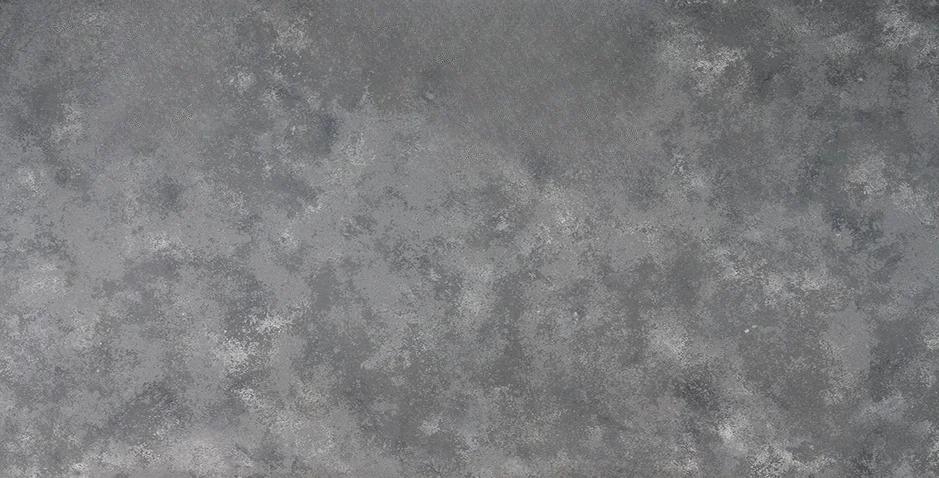
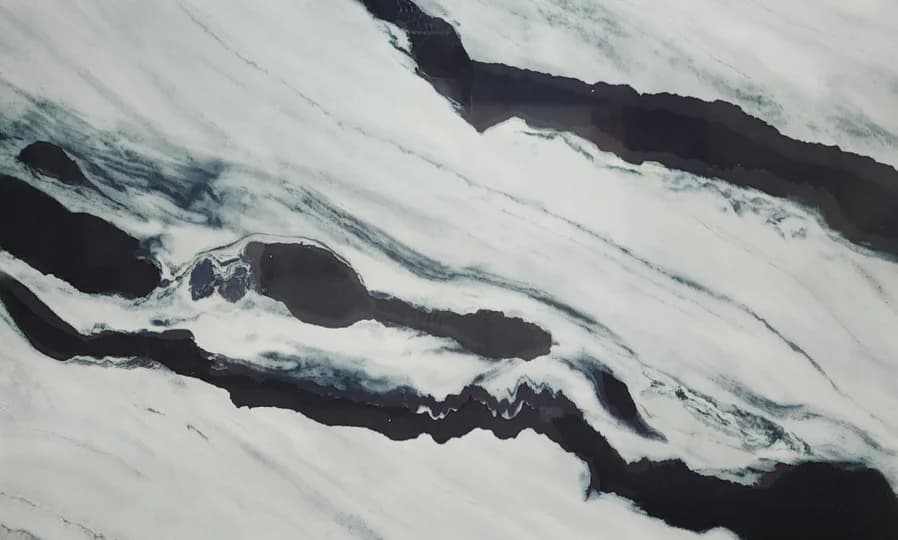
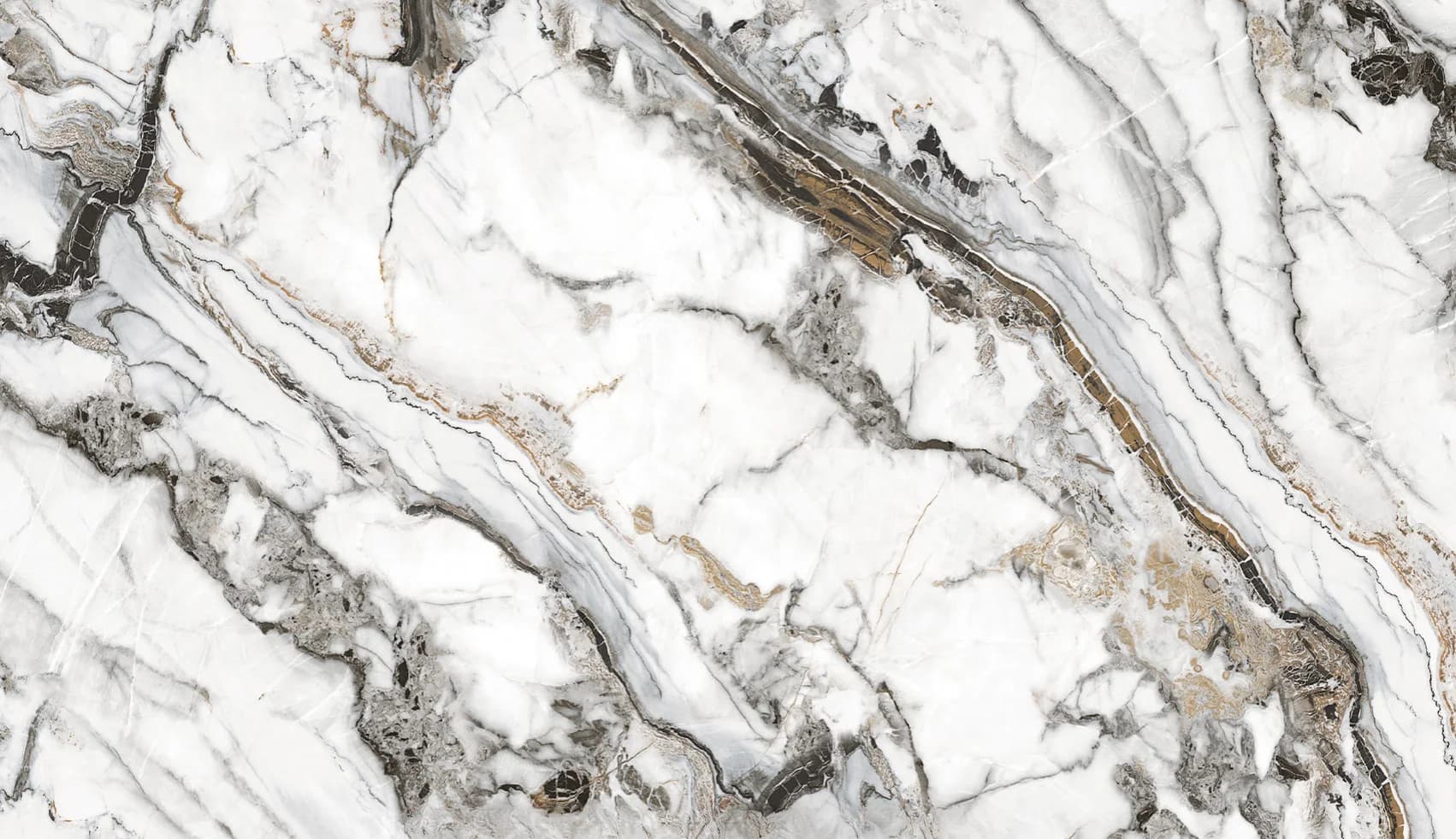
See a slab in a room before you commit with the visualizer, or visit the Dallas showroom and choose the exact slab by its tag.
Questions people ask
How do you clean quartz countertops?
Wipe them with a soft cloth and warm water, with a little mild soap if you like, then dry. Quartz makers name this routine, and tell you to avoid bleach, oven cleaner, paint remover, abrasive powders and strong acids or alkalis.
Do quartz countertops stain?
They resist stains because the surface has low porosity, but they are not stain-proof. Wipe spills promptly, and keep strong chemicals such as bleach, oven cleaner and paint remover off the surface, because makers warn that those can damage it.
Source: Cosentino, Use and care: Silestone and ECO Line Colour Series
Are quartz countertops heat resistant?
Only up to a point. Cambria says its quartz is not heat-proof and may not withstand direct heat from pots and pans, and that a sudden change of temperature can damage the surface. It recommends a closed-weave hot pad or solid trivet, and the other makers give the same advice.
Can I put a hot cup of coffee on quartz?
No maker’s care guide sets a temperature for a mug, and the sources that do give numbers disagree. Silestone says not to place any object that gives off heat straight onto the surface. Use a coaster, and keep a trivet by the stove for pans.
Source: Cosentino, Use and care: Silestone and ECO Line Colour Series
Can I use Clorox wipes on quartz?
Clorox says its Disinfecting Wipes can be used on hard, nonporous quartz when used as directed, and marks its Disinfecting Bleach and Disinfecting All Purpose Cleaner as not suitable. Caesarstone says to make sure any wipe is safe for quartz, so check your maker’s guide.
What is the downside to quartz countertops?
The resin limits it. Heat can damage it, direct sun can fade standard indoor quartz, seams show, edges can chip, and cutting the slab makes silica dust that harms the workers who fabricate it.
How much do quartz countertops cost?
The price depends on the design, the slab thickness, the edge profile, the number of cutouts and seams, labor, and site access. Ask your fabricator for a quote that itemizes each, and whether removing the old countertop is included.
How do you polish quartz countertops?
You don’t. A polished slab leaves the factory polished, Cambria says not to apply sealers or topical treatments because they wear off and leave the gloss dull or inconsistent, and Silestone says not to polish the surface. Keep to warm water and mild soap.
Source: Cosentino, Use and care: Silestone and ECO Line Colour Series
Sources
Each page was read on unless its own date is given.
- 1Wikipedia, Engineered stone
- 2Breton, The story of BretonStone
- 3National Park Service, Mohs hardness scale
- 4Cambria, Product care and maintenance information (March 2025)
- 5Cambria, Slab product information
- 6Cambria, Quartz countertops price information
- 7Caesarstone, Care and maintenance
- 8Caesarstone USA, Residential Lifetime Warranty (Rev. 112020)
- 9Caesarstone, Does Quartz Fade in Sunlight? (2021)
- 10Caesarstone, Outdoor Technical Guide, US (February 2021)
- 11Caesarstone, Common mistakes in fabrication, installation and post-installation
- 12Caesarstone, How to Disinfect Quartz Countertops Safely (2021)
- 13Cosentino, Use and care: Silestone and ECO Line Colour Series
- 14Hyundai L&C, HanStone Quartz fabrication manual (2024)
- 15MSI, Everything you need to know about protecting your quartz countertop from heat (updated August 2026)
- 16MSI, How much does a slab of quartz cost? (updated October 2026)
- 17Clorox, How to clean quartz countertops
- 18Cecile Rose et al., Severe Silicosis in Engineered Stone Fabrication Workers, CDC MMWR 68(38) (September 27, 2019)
- 19Fazio et al., Silicosis Among Immigrant Engineered Stone (Quartz) Countertop Fabrication Workers in California, JAMA Internal Medicine 183(9) (2023), CDC Stacks record
- 20OSHA, Lessons learned and initial findings from OSHA’s emphasis program on silica in engineered stone
- 21Caesarstone, Technical Data Manual (2021)
- 22OSHA, 29 CFR 1910.1053, Respirable crystalline silica
- 23Natural Stone Institute, Got Data? Testing the Performance of Granite, Engineered Quartz, Concrete, and Sintered Countertop Surfaces (Karin Kirk, 2019)
- 24Natural Stone Institute, Granite vs. Engineered Quartz for Your Kitchen Countertop (Stephanie Vierra, 2019)
- 25Safe Work Australia, Engineered stone ban
- 26Cosentino, Silestone maintenance (US site)