
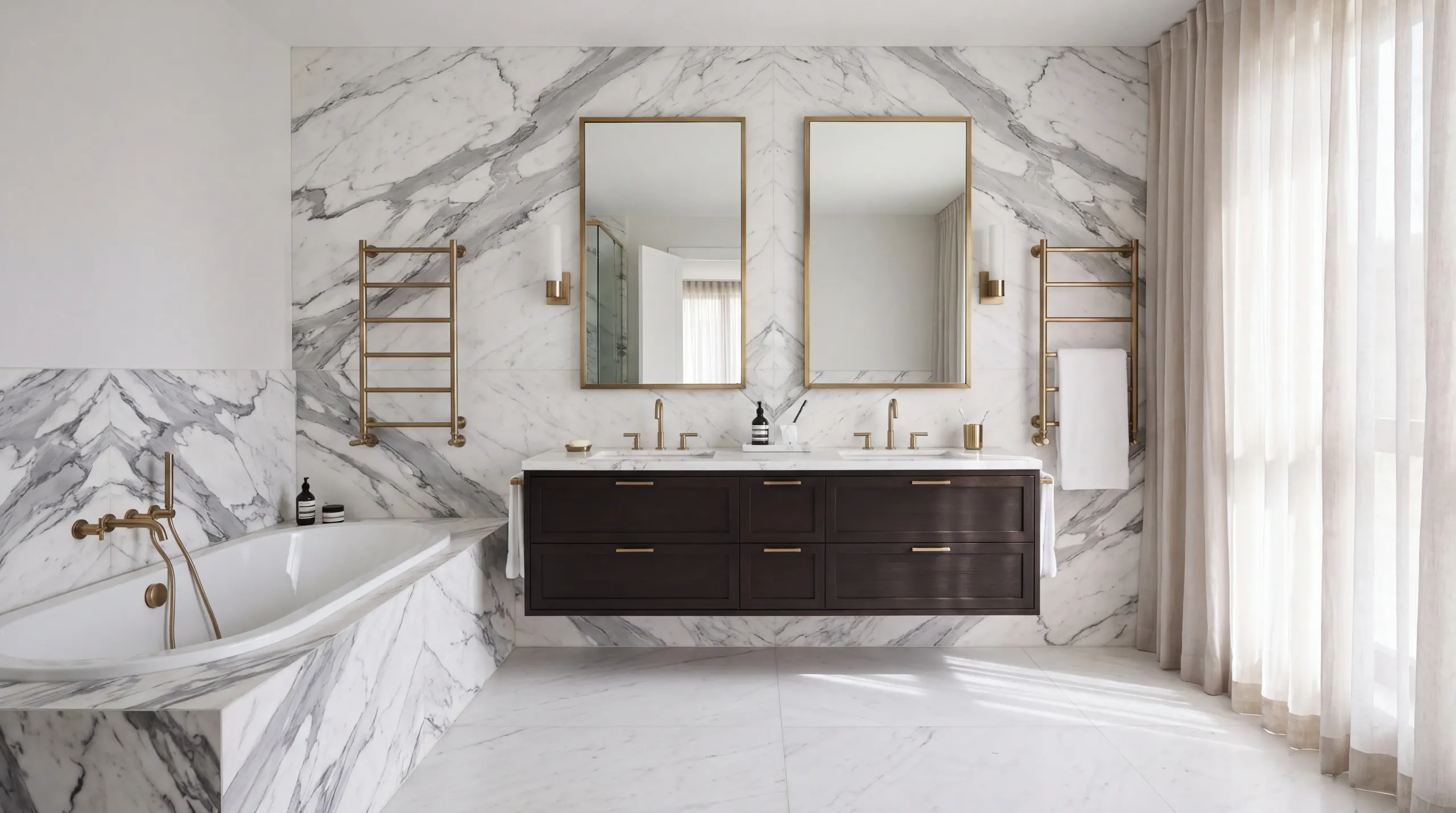
Calacatta Gold: what it is and how to choose the right slab
What Calacatta Gold is, how it differs from Carrara and Statuario, and how the marble, quartz and porcelain versions compare.
KLZ Stone Supply · · Updated · 15 min read
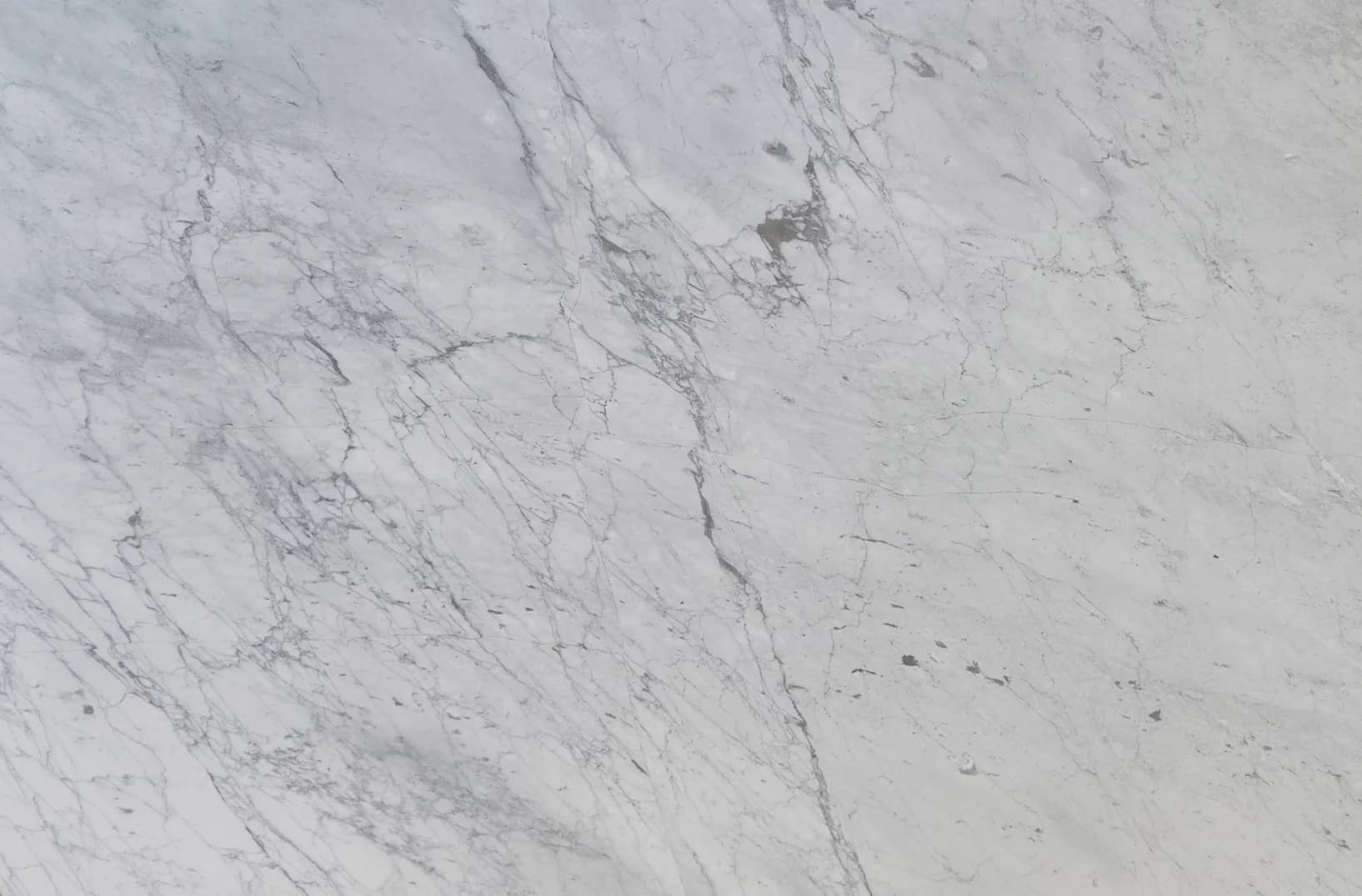
Calacatta ApuanoMarble

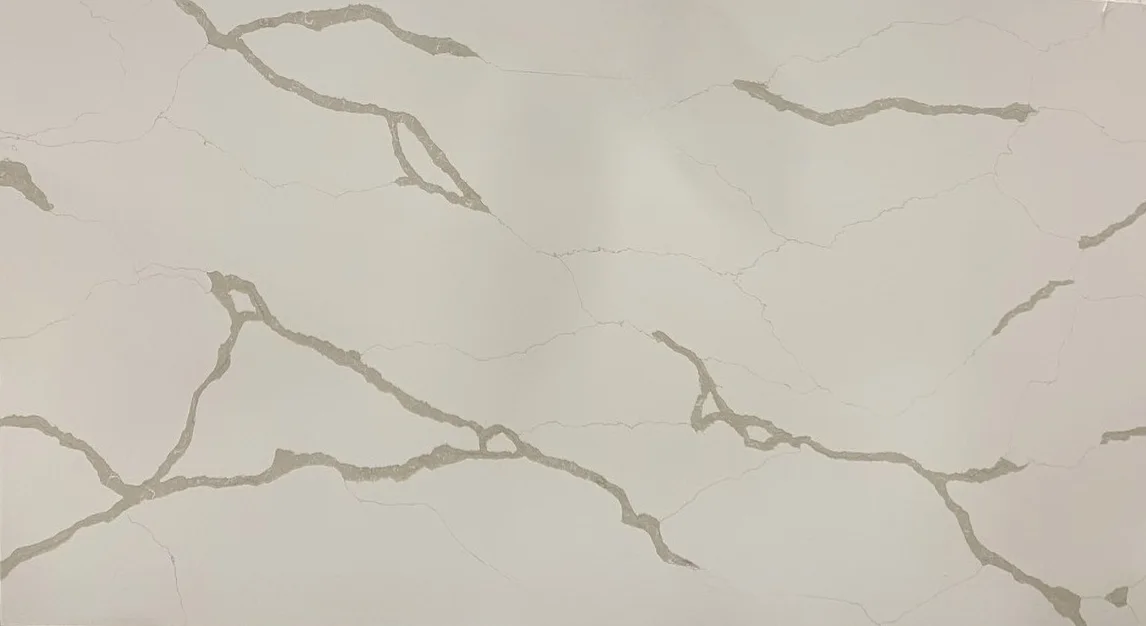
Calacatta GoldQuartz
What is Calacatta Gold?
Calacatta Gold is a marble from the Carrara area in the Apuan Alps of Tuscany, Italy. Wikipedia lists it among the more expensive varieties of Carrara marble, quarried throughout the Carrara area.16 Remodelista says Calacatta is quarried there too, like the more common Carrara.4
Marble is limestone, mostly the mineral calcite, that heat and pressure changed. When a limestone seabed is dragged down into the Earth's crust, the Natural Stone Institute says, “the additional heat transforms the calcite grains and fuses them together tightly.”1 In the Apuan Alps, that pressure came about 25 million years ago.3
Classic white marble “is pure calcite, without intervening minerals to lend it color,” and iron oxide tints pink marble and golden marble.1 A stone-company salesperson quoted by Remodelista calls Calacatta's veins thick and dramatic, ranging from gold to brown to beige to dark gray.4
“Calacatta Gold” is also a look that makers of quartz, porcelain, and sintered stone copy. Cosentino's own guide says some Silestone products “are created and designed to resemble natural stone.”10 KLZ's catalog shows the split: its Calacatta Gold is filed under quartz, not marble.
Is Calacatta Gold marble or quartz?
It can be either, and the name doesn't say which. The material belongs on the quote.
One name in KLZ's catalog sits on three materials. Calacatta Borghini Honed is filed under marble, Calacatta Borghini under quartz, and Calacutta Borghini under porcelain (the feed spells that one Calacutta). Calacatta Fox adds a fourth, filed under quartzite.
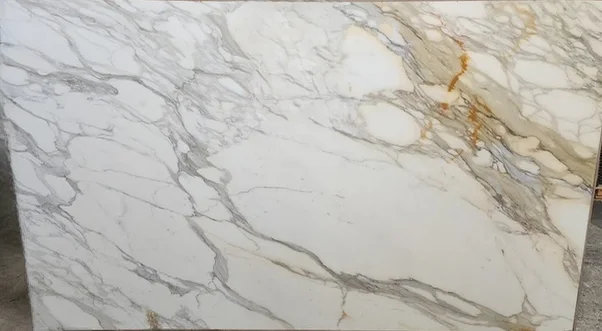
Ask three things before you fall for a photograph: the material class, who made it and in which product line, and the finish. The first answer settles most of the care questions that follow. For the natural stone, start with the marble catalog. The quartz and porcelain catalogs hold the look-alikes.
What is the difference between Calacatta, Carrara, and Statuario?
They differ in ground color and veining. Carrara has a gray field and soft veins. Calacatta has a bright white field and thick veins. Statuario has a bright white field and dark gray veins.4
Ground color4
- Carrara
- Gray field, sometimes leaning blue-gray
- Calacatta
- Bright white
- Statuario
- Bright white
Veins4
- Carrara
- Light gray, usually soft and feathery
- Calacatta
- Thick and dramatic, gold to brown to beige to dark gray
- Statuario
- Usually dark gray
Contrast and color range4
- Carrara
- Less color variation than Calacatta
- Calacatta
- “A lot more variation in color than Carrara”
- Statuario
- Strong light-to-dark contrast, with less color variation than Calacatta
Supply4
- Carrara
- The most quarried and the best priced of the three
- Calacatta
- Rarer, more coveted, priced higher
- Statuario
- Priced about the same as Calacatta in the article's text; its FAQ says lower
| Carrara | Calacatta | Statuario | |
|---|---|---|---|
| Ground color4 | Gray field, sometimes leaning blue-gray | Bright white | Bright white |
| Veins4 | Light gray, usually soft and feathery | Thick and dramatic, gold to brown to beige to dark gray | Usually dark gray |
| Contrast and color range4 | Less color variation than Calacatta | “A lot more variation in color than Carrara” | Strong light-to-dark contrast, with less color variation than Calacatta |
| Supply4 | The most quarried and the best priced of the three | Rarer, more coveted, priced higher | Priced about the same as Calacatta in the article's text; its FAQ says lower |
The salesperson says there is “really no difference between these stones in terms of porosity.” The article's own FAQ says Statuario has lower porosity. Check the specifications of the slab you are buying, not the name.4
Does real Calacatta Gold marble etch, stain, and need sealing?
It etches, it stains less than its reputation says, and it needs sealing against stains but not against etching.
Etching
The Natural Stone Institute says calcite is “chemically reactive with common acids, such as those found in lemonade, wine, and colas,” so a tiny amount of stone dissolves. “On a polished stone, an etch looks like an unpolished area.”1 Restorers name tomatoes, citrus, juices, alcohol, and vinegar as the usual causes of that dull spot or burn mark.2
An etch doesn't affect the integrity of the stone. It changes the color or luster, and it can be polished out or left as patina.1 Sealing doesn't help: “sealing does not make marble any less prone to etching.”1
Staining and sealing
The Institute calls the idea that marble stains easily “a common misconception” and says staining is “actually quite rare,” because the metamorphism “knits the minerals together tightly.” Marble's porosity is “similar” to granite's, though it advises testing a sample of the stone you are buying.1
Restorers are less relaxed: red wine and oil are two of the biggest culprits, and a spill left on the surface will stain.2 A sealer slows that. Experts disagree about how often to reseal, so follow the product label. To test, put a few drops of water on the stone and wait. A dark spot means the water has soaked in and the stone needs sealing.2 For daily cleaning, see the care guide.
Scratches, chips, and finish
One restorer calls marble “softer and prone to scratches and etching.”2 An impact at an edge can chip or flake it.1 Another restorer says you may notice etching more on polished marble than on honed or textured marble, and calls a kitchen with honed or textured marble “more practical than polished.”2
Marble upkeep is counted in years
How does Calacatta Gold quartz compare with the marble?
Quartz copies the look in crushed stone and resin, and its main limits are heat and sun.
Wikipedia gives engineered quartz as about 93% stone aggregates and 7% polyester resin by weight, compressed under vacuum into slabs with virtually no porosity.9 Caesarstone calls its surfaces “incredibly durable and nonporous.”7 Caesarstone says quartz is “manufactured to ensure consistent color and pattern.”6
Engineered stone contains substantially more silica than granite
Heat
Wikipedia says quartz “is less heat resistant than other stone surfaces including most granite, marble and limestone.”9 Caesarstone's care page says “Always place hot cookware on trivet and hot pads.”7 On quartz, a trivet is the rule.
Sun and outdoor use
Keep quartz Calacatta Gold indoors. The polyester resins “are not completely UV stable and engineered stone should not be used in outdoor applications.”9 Caesarstone says indoor quartz can fade under prolonged direct sunlight, which typically happens only outside. Window light is much less likely to do it unless it lands directly on the countertop for extended periods.8 Cosentino says of Silestone: “Under no circumstances should this material be installed for outdoor countertops.”10
What about Calacatta Gold in porcelain or sintered stone?
Both copy the look, and at least one sintered stone maker markets its slabs for heat and sun. Neolith, a sintered stone maker, says its material “is resistant to scratches, high temperatures and UV rays,” and that its colors are not distorted by sun or extreme weather.11 Caesarstone, a quartz maker, lists sintered stone among the materials that may not suit a waterfall edge, calling it “brittle and susceptible to chipping from impact.”6 Both are makers describing their own or a rival's product, so ask for the documents for the slab itself.
KLZ's catalog lists porcelain slabs in the look: Calacutta Bianco Oro and Calacutta Borghini. The inventory lists them at 12 mm, against 2 cm and 3 cm for the marble and quartz Calacattas KLZ lists. Ask your fabricator whether the thinner slab changes how it is supported and edged.
The porcelain Calacattas are thinner than the marble and quartz ones
- Porcelain Calacattas12 mm
- Marble and quartz Calacattas2 cm and 3 cm
Do the veins run through the slab or sit on the surface?
In marble they run through, because the pattern is the stone. In quartz and porcelain it depends on how the slab was made, and you have to ask.
A marble slab is a slice of a quarried block, so the face and the edge are the same stone.5 A trade blog post on Infinity Surfaces, one porcelain maker's technology (published by SA Decor & Design), describes veining that “also runs through the body of the slab” and says “Usually this does not occur.” The benefit is that “if the material is cut, the vein will show.”12
A patent for an engineered stone slab says the veining and color is ideally “through body,” running through the entire thickness, “because countertops have finished edges that can be seen.” It adds that the pattern inside “may not exactly represent the surface pattern,” and that some methods combine traditional techniques with digital printing to build a through-bodied slab.13 It is one inventor's view, not any one brand, so it tells you what to ask.
A thick, mitered, or waterfall edge exposes the inside of the slab. A mitered edge is cut at 45 degrees, so the top and side pieces meet without a visible seam where the surface patterns merge.6 Ask the maker whether the pattern runs through the slab, and look at a cut edge or an offcut of the same product.
How do book-matching and vein direction work at seams and waterfall edges?
Book-matching mirrors two neighboring slabs, vein-matching carries one vein across a seam, and both have to be planned before anything is cut.
Book-matching
Open two neighboring slabs like a book and polish the surfaces that faced each other. The Natural Stone Institute says the pattern on each is virtually identical, except that the two are mirror images.5 That takes neighboring slabs from one block, and the matching surfaces are usually prepared when they are cut from it, not commonly in a fabricator's shop. Bookmatching “tends to be more expensive than a standard layout, because in every case two slabs are needed,” and if one slab is lost to breakage, the whole layout can be lost.5 Laminam, a porcelain maker, describes its bookmatched slabs as a “mirror image pattern with fully bookmatched intertwining veins.”15
Any of the four edges of two slabs can be joined, and swapping them left to right or top to bottom gives a different pattern.5
Vein direction at seams and waterfalls
Vein-matching, which the Institute also calls slip-matching, lines up the key visual elements so the pattern flows across seams. It is “commonly seen on ‘waterfall’ arrangements,” where a countertop meets a vertical panel, and there it is “typically preferred over bookmatch.”5
Caesarstone lists “natural stone with bold, large-scale veining with patterns that don't align seamlessly” among the materials that may not suit a waterfall edge, and calls quartz the industry standard for waterfalls because it is made with consistent color and pattern. It also says making the top and side panels look like one continuous piece “can be challenging.”6
For an inconsistent pattern, the fix is the layout. Cosentino tells fabricators to place the slab on the cutting table, clean it, and mark a layout of the pieces. The marks identify tone and vein pattern, so joints match by tone or vein.10
How do you choose a Calacatta slab for your kitchen?
Choose the slab, not a sample or the name, and decide where the veins and the seams go before the fabricator cuts.
See the whole slab
Remodelista says each piece of marble is one of a kind, so you will probably want to look at the actual slabs before you decide.4 KLZ's stone pages show each slab whole, and you can choose in the showroom. Homeowners choose the slab and buy through their fabricator.Decide where the boldest veins land
Pick the pattern you want on the island face, the waterfall, or the wall behind the cooktop. Point to it when you meet your fabricator. The visualizer shows a stone in a room first.Place seams away from the sink and cooktop
Cosentino's installation guide says it “does not recommend leaving joints in the cut-out area” of a sink or cooktop.10 Ask your fabricator where the seams fall and why.If you want a match, ask for consecutive slabs
The Institute says consecutively polished slabs are usually numbered so you can buy neighbors.5 Ask whether yours are consecutive, and how many a match needs for your layout.Mock up the layout
The Institute suggests printing two photographs of a slab, or mirroring one in a slide, and moving the copies around to see each arrangement.5 The tool in the next section puts slabs side by side at one scale.Confirm the material in writing
Put the material class, the maker and product line (for a manufactured slab), the thickness, and the finish on the quote.
How big are the veins on each Calacatta slab, really?
Compare them at one scale: this tool draws two to four Calacatta slabs from KLZ's catalog. It uses each slab's measured size, so you see the veins at their real proportions.
Tool
Compare Calacatta slabs side by side
Choose up to four slabs. The photographs are never cropped.
Change the slabs: 3 of 4 chosen
Comparing 3 slabs: Calacatta Apuano, Oriental Calacatta, Calacatta Gold. Each photograph is fitted to its own box, so sizes are not to scale with each other.
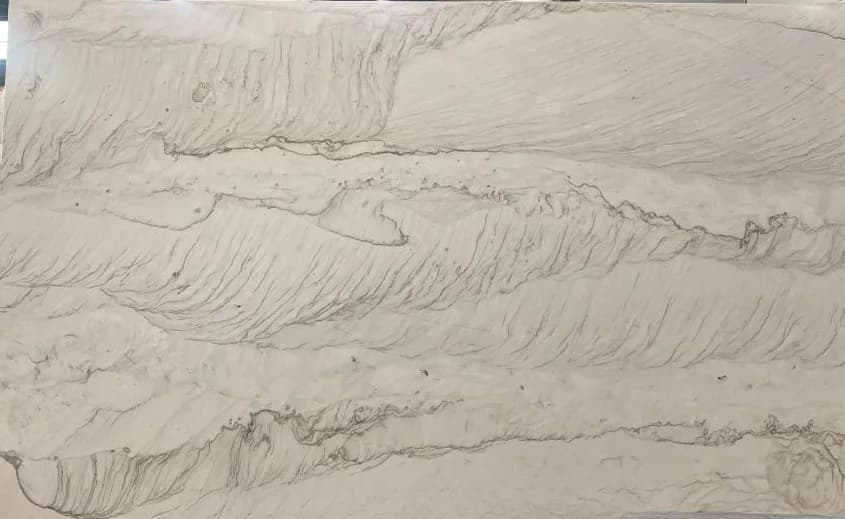
Calacatta ApuanoMarble, 2cm108 × 71 in 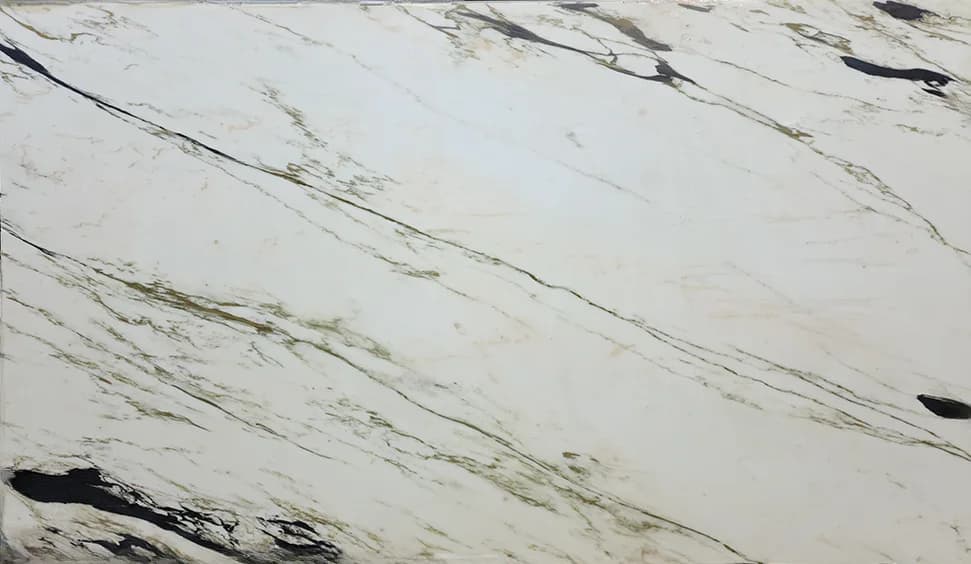
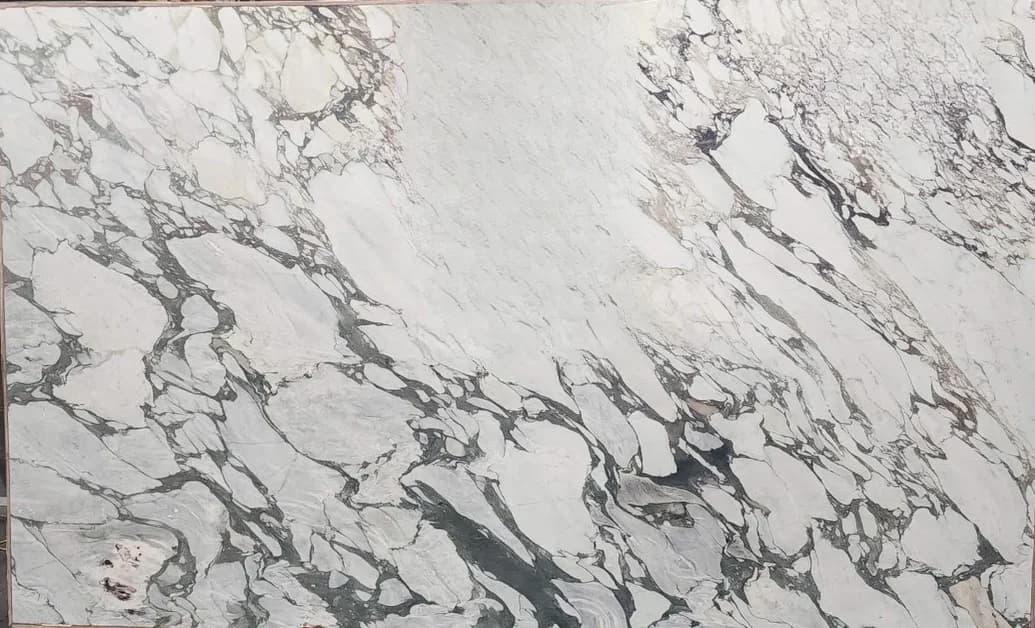
Oriental CalacattaMarble, 2cm136 × 79 in Calacatta GoldQuartz, 3cm135 × 79 in
Marble, 2cm
108 × 71 in, or 108 in (9 ft) long
Marble, 2cm
136 × 79 in, or 136 in (11 ft 4 in) long
Quartz, 3cm
135 × 79 in, or 135 in (11 ft 3 in) long
What the sizes assume
- Sizes are the average KLZ has measured for slabs of that product, long side first. The photograph shows one slab, which can differ from the average by a few inches.
- In the same-scale view, the long side of each slab is the width of its photograph. The list leaves out slabs whose photograph does not match their measured shape, and prefabricated pieces.
- A photograph is a guide to the pattern, not to the color on your screen. Choose the slab itself at the yard.
Which Calacatta Gold should you choose: marble, quartz, or porcelain?
Choose marble if you want the stone and will care for it. Choose quartz if you want an even pattern with no sealing and will keep it indoors. Choose porcelain or sintered stone if heat and sun matter most and you have checked the edge.
Made of
Acid
- Marble
- Etches1
- Porcelain or sintered stone
- Ask the maker
Sealing
- Marble
- Seal against stains2
- Porcelain or sintered stone
- Ask the maker
Hot pans
Sun and outdoors
- Marble
- Not covered by the sources read here
- Porcelain or sintered stone
- One sintered stone maker claims UV resistance11
Veins through the slab
Pattern from slab to slab
| Marble | Quartz | Porcelain or sintered stone | |
|---|---|---|---|
| Made of | Mostly calcite, from a quarried block15 | Mostly crushed stone in a resin9 | Natural raw materials, sintered, says one maker11 |
| Acid | Etches1 | Mostly silica, not calcite; ask the maker about acids914 | Ask the maker |
| Sealing | Seal against stains2 | Nonporous, and one maker says it never needs sealing717 | Ask the maker |
| Hot pans | Use trivets2 | Less heat resistant than marble; trivet always97 | One sintered stone maker claims high-temperature resistance11 |
| Sun and outdoors | Not covered by the sources read here | Indoors only910 | One sintered stone maker claims UV resistance11 |
| Veins through the slab | Yes, it is the stone5 | Ask; one patent calls through-body the ideal13 | Ask; one porcelain maker says through-body veining is not usual12 |
| Pattern from slab to slab | Every slab differs4 | Made to be consistent6 | Ask the maker |
Why does Calacatta cost more than Carrara?
Supply, and the amount of slab a good layout uses. KLZ doesn't publish prices and quotes each slab once you know which one you want.
Remodelista traces the Carrara-to-Calacatta gap to supply and demand. More Carrara is quarried and it is seen as less high-end, while Calacatta is rarer and more coveted.4 A match adds more. Book-matching needs two slabs even for a small area, and the planning and fabrication can add cost.5 A waterfall edge needs more material and specialized CNC fabrication.6
Material, thickness, finish, and seam count all change a quote, so compare quotes for the same layout. KLZ supplies the slab, and your fabricator templates, cuts, and installs it. To start, contact KLZ or visit the showroom.
Questions people ask
What is Calacatta Gold quartz?
It is an engineered quartz slab, made from crushed stone and resin, whose pattern copies Calacatta marble: a white field with thick veins. The name describes the look, not the material, so the maker and product line are what identify the slab. Engineered quartz has virtually no porosity, but it is less heat resistant than most granite and marble and is not completely UV stable, so use a trivet and keep it indoors.
Source: Wikipedia, Engineered stone
Is Calacatta Gold marble?
Originally, yes. Wikipedia lists Calacatta Gold among the more expensive varieties of Carrara marble, quarried throughout the Carrara area of Italy. The name is also used for quartz, porcelain, and sintered stone slabs that copy the look, so ask what material a slab is and which class its seller files it under.
Source: Wikipedia, Carrara marble
What is the difference between Calacatta and Carrara?
Ground color and veins, according to a salesperson quoted by Remodelista. Carrara has a gray field with light gray, usually soft and feathery veins. Calacatta has a bright white field with thick, dramatic veins that run from gold to brown to beige to dark gray. Both are quarried in Carrara, and Calacatta is rarer and more coveted.
Source: Remodelista, The Difference Between Carrara, Calacatta, and Statuary Marble
Is Silestone real marble?
No. Cosentino's own installation guide says some Silestone products are created and designed to resemble natural stone, which makes them a manufactured look, not quarried marble. The same guide recommends Silestone for indoor use only and says that under no circumstances should it be installed for outdoor countertops.
Source: Cosentino, Silestone Countertops: Design and Installation (Rev. 03, February 2024)
What is Calacatta Miraggio Gold?
It is a quartz in MSI Surfaces' Q Studio collection. MSI describes it as a dramatic quartz with a marble-inspired look, a crisp white background, and golden brown veining. It is a manufactured product with its own maker, not the Italian marble.
Source: MSI Surfaces, Calacatta Miraggio Gold Q Countertop Surface
Does Calacatta Gold marble stain or etch?
It etches. Marble is mostly calcite, and acids such as those in lemonade, wine, and cola dissolve a little of the surface, leaving a slight change in color or luster. Sealing doesn't prevent etching. Staining is rarer than its reputation says, and marbles are typically sealed to reduce the likelihood of staining.
Source: Natural Stone Institute, Mad About Marble: A Geological Look at a Classic Stone
Can you use Calacatta Gold quartz outdoors?
Not standard indoor quartz. Its polyester resin is not completely UV stable, and one maker's own guide says its quartz should never be installed for outdoor countertops. For a covered or sunny outdoor kitchen, ask the maker whether a specific product is rated for it, or consider a porcelain or sintered stone slab whose maker rates it for outdoor use.
Source: Wikipedia, Engineered stone
Sources
Each page was read on unless its own date is given.
- 1Karin Kirk, Mad About Marble: A Geological Look at a Classic Stone, Natural Stone Institute (February 15, 2018)
- 2Stephanie Vozza, How to Care for Your Marble Countertops, Natural Stone Institute (February 6, 2019)
- 3Wikipedia, Apuan Alps
- 4Barbara Peck, Remodeling 101: The Difference Between Carrara, Calacatta, and Statuary Marble, Remodelista (September 2, 2021)
- 5Karin Kirk, Bookmatching: Geology Meets Geometry, Natural Stone Institute (December 21, 2018)
- 6Caesarstone, Waterfall Countertops: What to Know About This Popular Edge Profile (December 12, 2025)
- 7Caesarstone, Care and maintenance
- 8Caesarstone, Does Quartz Fade in Sunlight?
- 9Wikipedia, Engineered stone
- 10Cosentino, Silestone Countertops: Design and Installation, technical content (Rev. 03, February 2024)
- 11Neolith, What is Neolith?
- 12SA Decor & Design, Infinity Surfaces: All You Need to Know about Natura-Vein Tech (December 6, 2023)
- 13US Patent 12,202,288 B2, Engineered stone slab, and apparatus and method for creating, Google Patents
- 14Cecile Rose et al., Severe Silicosis in Engineered Stone Fabrication Workers, CDC MMWR 68(38) (September 27, 2019)
- 15Laminam, A guide to bookmatched surfaces
- 16Wikipedia, Carrara marble
- 17Caesarstone, How To Take Care of Quartz Countertops (March 30, 2020)